







The Ecommerce Logistics Stack Explained: OMS, WMS, TMS, 3PL, 4PL & CX Ownership
Estimated reading time: 9 minutes
In the rapidly evolving digital marketplace, logistics is no longer just a back-office function; it is a critical driver of customer satisfaction and brand loyalty. As businesses in Vietnam and across the globe shift toward omnichannel strategies, the complexity of moving a product from a digital shopping cart to a customer’s doorstep has intensified. This complexity has given rise to what experts call the “logistics stack”—a layered ecosystem of software and service providers that work in harmony to ensure speed, accuracy, and cost-efficiency.
Understanding The Ecommerce Logistics Stack Explained: OMS, WMS, TMS, 3PL, 4PL & CX Ownership is essential for any business leader looking to scale. Whether you are a local Vietnamese brand expanding internationally or a global enterprise optimizing your Southeast Asian footprint, the way you integrate these technologies and partnerships defines your operational resilience. This guide breaks down each layer of the stack, exploring how they interact and who ultimately “owns” the customer experience in a multi-layered supply chain.
Table of Contents
- The Digital Brain: Order Management Systems (OMS)
- The Operational Core: Warehouse Management Systems (WMS)
- Moving the Goods: Transportation Management Systems (TMS)
- The Ecommerce Logistics Stack Explained: 3PL vs. 4PL Models
- CX Ownership: The Final Frontier of Logistics
- Practical Lessons for Logistics Professionals
- How Scanwell Logistics Vietnam Can Help
- Conclusion
- FAQ
The Digital Brain: Order Management Systems (OMS)
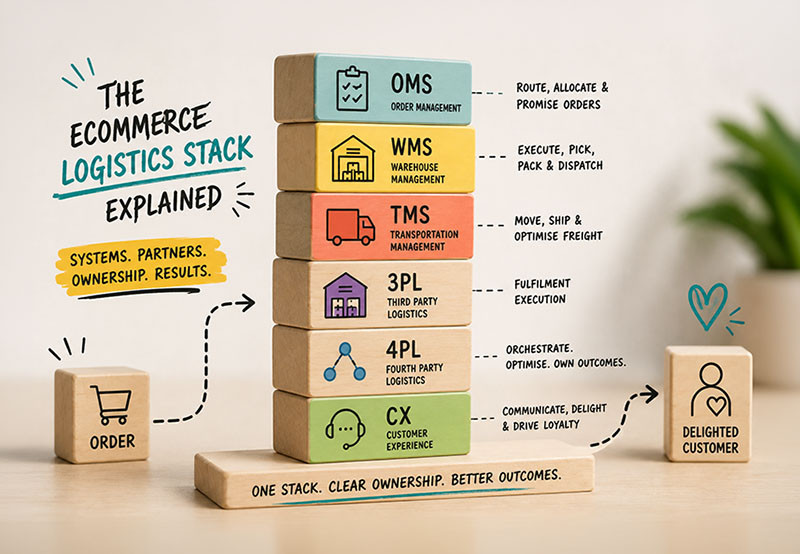
At the very top of the ecommerce logistics stack sits the Order Management System (OMS). Think of the OMS as the “brain” of your entire operation. Its primary role is to aggregate orders from various sales channels—such as your website, Shopee, Lazada, Amazon, or even physical retail stores—and route them to the most appropriate fulfillment location.
An effective OMS provides a single source of truth for inventory. Without it, a brand risks overselling products because the inventory levels on TikTok Shop might not sync fast enough with the levels on the main webstore. The OMS ensures that once an order is placed, it is validated, payment is confirmed, and the data is passed down the stack for physical processing.
- Multi-channel Integration: Consolidating orders from disparate platforms into one dashboard.
- Order Routing: Automatically selecting the warehouse closest to the customer to reduce shipping time.
- Inventory Visibility: Tracking “available to promise” stock across the entire network.
The Operational Core: Warehouse Management Systems (WMS)
Once the OMS has processed an order, it sends the data to the Warehouse Management System (WMS). If the OMS is the brain, the WMS is the “central nervous system” of the physical warehouse. It controls every movement within the four walls of the facility, from the moment goods are received at the dock to the moment they are packed into a shipping box.
In the context of ecommerce, where “speed to ship” is a competitive advantage, a WMS is indispensable. It optimizes picking routes for warehouse staff, manages bin locations, and ensures that the “first-in, first-out” (FIFO) principle is maintained. For businesses in Vietnam dealing with high volumes during “Double Day” sales (like 11.11 or 12.12), a robust WMS prevents the chaos that often leads to shipping errors and delayed deliveries.
Key functionalities of a modern WMS include:
- Real-time Stock Tracking: Knowing exactly where every SKU is located.
- Labor Management: Tracking the productivity of picking and packing teams.
- Quality Control: Ensuring the right item is in the right box before the label is applied.
Moving the Goods: Transportation Management Systems (TMS)
The final software layer in the stack is the Transportation Management System (TMS). This system takes over once a package is ready for dispatch. Its job is to find the most efficient and cost-effective way to get the parcel to the end customer. In the complex geography of Vietnam—ranging from bustling urban centers like Ho Chi Minh City to remote mountainous provinces—a TMS is vital for managing “last-mile” delivery.
The TMS evaluates various carriers (such as GHTK, GHN, or DHL), compares shipping rates, prints shipping labels, and provides tracking information back to the OMS and the customer. By automating carrier selection based on pre-defined rules (like price or delivery speed), a TMS saves logistics managers hours of manual work and significantly reduces transportation spend.
Route Optimization: Mapping the most efficient path for delivery fleets to save fuel and time.
The Ecommerce Logistics Stack Explained: 3PL vs. 4PL Models
While the software layers (OMS, WMS, TMS) provide the digital infrastructure, the physical execution often involves third-party partners. This brings us to the distinction between 3PL and 4PL providers, a cornerstone of The Ecommerce Logistics Stack Explained: OMS, WMS, TMS, 3PL, 4PL & CX Ownership.
Third-Party Logistics (3PL)
A 3PL provider offers functional logistics services. You outsource the “doing” to them—warehousing, picking, packing, and distribution. A 3PL typically owns or leases warehouse space and operates its own or partnered transportation fleets. This model is ideal for brands that want to offload the headache of managing warehouse staff and physical assets but still want to maintain a level of direct control over their supply chain strategy.
Fourth-Party Logistics (4PL)
A 4PL, or “Lead Logistics Provider,” takes it a step further. A 4PL doesn’t just execute; they integrate. They act as a single point of contact that manages multiple 3PLs, technology vendors, and other service providers on behalf of the client. The 4PL “owns” the entire supply chain design and optimization. For rapidly scaling ecommerce companies, a 4PL provides a strategic layer of management that allows the brand to focus entirely on marketing and product development.
CX Ownership: The Final Frontier of Logistics
The term “CX Ownership” refers to who is responsible for the Customer Experience. In the traditional model, once a package left the warehouse, the brand lost visibility, and the “experience” was handed over to the courier. If a package was late or lost, the customer blamed the brand, even though the brand had no control over the courier’s performance.
Today, high-performing ecommerce brands “own” the CX through the entire logistics stack. They use integrated data to provide proactive shipping updates, branded tracking pages, and seamless returns processes. By ensuring that the OMS, WMS, and TMS are perfectly synced, the brand can maintain a consistent voice and provide reliable information to the customer from the “Buy Now” button to the “Unboxing” moment.
Ownership of CX in logistics means:
- Proactive Communication: Telling the customer there is a delay before they have to ask.
- Branded Fulfillment: Using custom packaging and inserts that reinforce the brand identity.
- Seamless Returns: Making the reverse logistics process as easy as the purchase process.
Practical Lessons for Logistics Professionals
Building a logistics stack is not about buying every piece of software available; it’s about building a cohesive ecosystem. Here are some practical takeaways:
- Start with Integration in Mind: Ensure your OMS can “talk” to your WMS and TMS via APIs. Data silos are the enemy of speed.
- Scale Your Partners with Your Volume: A small brand might only need a simple WMS, but a growing enterprise might require a 3PL with international capabilities and advanced automation.
- Leverage Data for CX: Use the tracking data from your TMS to create a branded tracking experience. Don’t just send customers to a generic courier website.
- Focus on Compliance: In markets like Vietnam, ensure your logistics stack accounts for local tax regulations and customs documentation if you are selling cross-border.
How Scanwell Logistics Vietnam Can Help
At Scanwell Logistics Vietnam, we understand that the ecommerce logistics stack is more than just acronyms; it is the backbone of your business. We provide the physical infrastructure and the technological connectivity required to turn logistics into a competitive advantage. Our team acts as a trusted partner, helping you navigate the complexities of 3PL and 4PL models while ensuring your customer experience remains top-tier.
Whether you need specialized warehousing for ecommerce fulfillment or expert freight forwarding to move goods across borders, Scanwell integrates seamlessly into your existing stack.
- Ocean Freight: Reliable FCL and LCL services to move your inventory globally.
- E-commerce Fulfillment: Advanced WMS-driven warehousing and distribution tailored for high-volume online sales.
- Last-Mile Support: Coordination with local carriers to ensure timely delivery within Vietnam.
- Customs Brokerage: Navigating the regulatory landscape so your cross-border shipments never get stuck.
- End-to-End Visibility: Technology-enabled tracking that keeps you and your customers informed.
Conclusion
Navigating The Ecommerce Logistics Stack Explained: OMS, WMS, TMS, 3PL, 4PL & CX Ownership is a journey from operational necessity to strategic mastery. By understanding how the digital “brain” of the OMS coordinates with the physical “muscles” of the WMS and the “wheels” of the TMS, business leaders can build a supply chain that is both efficient and customer-centric.
As the Vietnamese market continues to grow as an ecommerce powerhouse, the ability to choose the right partners—be they 3PLs for execution or 4PLs for strategy—will separate the market leaders from the rest. Remember, logistics is the physical manifestation of your brand’s promise. When your stack works, your brand thrives.
Call to Action
Ready to optimize your ecommerce logistics stack and own your customer experience?
Explore Scanwell Logistics Vietnam
Contact our experts for a tailored logistics consultation
FAQ
What is the difference between an OMS and a WMS?
An OMS (Order Management System) focuses on the “front end”—capturing orders from various sales channels and routing them. A WMS (Warehouse Management System) focuses on the “inside”—managing the movement and storage of goods within the warehouse walls.
When should a brand move from a 3PL to a 4PL?
A brand should consider a 4PL when its supply chain becomes too complex to manage internally. If you are managing multiple 3PLs across different regions and struggle with fragmented data, a 4PL can provide the necessary strategic integration.
How does a TMS improve customer experience?
A TMS provides real-time tracking data and allows for “delivery choice” (e.g., standard vs. express). By feeding this data back to the customer, it reduces “where is my order” (WISMO) inquiries and builds trust.
Why is “CX Ownership” important in logistics?
Because the post-purchase phase—delivery and unboxing—is the most emotional part of the customer journey. Owning this experience ensures that logistics failures don’t become brand failures.