













The True Cost of Getting Compliance ‘Mostly Right’
Estimated reading time: 8 minutes
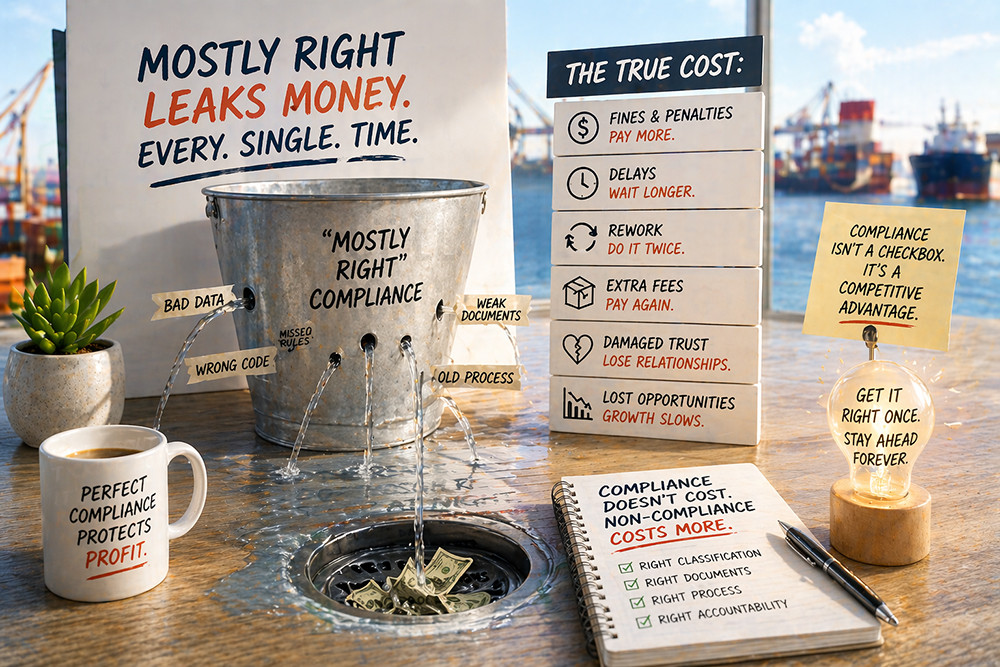
In the fast-paced world of global trade, logistics managers and supply chain directors are under constant pressure to move goods faster and cheaper. In this high-stakes environment, compliance is often viewed as a “box-ticking” exercise—a necessary hurdle that can be cleared with a “good enough” effort. However, as many businesses are discovering the hard way, The True Cost of Getting Compliance ‘Mostly Right’ is far higher than the investment required to get it exactly right.
For many organizations, “mostly right” feels like a safe middle ground. It assumes that if 90% of your documentation is accurate and your processes haven’t changed in a year, you are shielded from risk. In reality, compliance in logistics is not a sliding scale where you receive a “B grade” for partial effort; it is a trapdoor. When that door opens due to a single oversight, it can lead to financial hemorrhaging, operational paralysis, and long-term damage to a brand’s reputation.
As we navigate an era of increasing regulatory complexity and stricter government scrutiny, understanding the financial and operational implications of inadequate compliance is critical. Whether it is customs brokerage, environmental standards, or labor laws, the margin for error has vanished. This article explores why “mostly right” is a dangerous strategy and how logistics leaders can transition toward a culture of total compliance.
Table of Contents
- The Illusion of “Mostly Right” in Logistics
- Key Trends and Data: The Multi-Million Dollar Risk
- Operational Impacts: When the Trapdoor Opens
- Practical Lessons for Logistics Professionals
- How Scanwell Logistics Vietnam Can Help
- Conclusion
- FAQ
The Illusion of “Mostly Right” in Logistics
In many corporate departments, “mostly right” might be acceptable. A marketing campaign that hits 90% of its target audience is a success. But in the logistics industry, compliance functions differently. It is binary. A shipment is either compliant and allowed to pass through customs, or it is non-compliant and held at the port. There is very little room for “mostly” when a customs officer is reviewing a Bill of Lading or a Certificate of Origin.
The danger of the “mostly right” mindset is that it often relies on the “incumbency of process.” Businesses assume that because last year’s shipping routes and documentation survived scrutiny, they will survive this year’s audits. This is a false sense of security. Regulations are dynamic, not static. Governments frequently update trade tariffs, safety standards, and environmental requirements. Relying on yesterday’s solutions for today’s challenges is what leads to the “trapdoor” effect—where a previously accepted practice suddenly becomes a liability.
Furthermore, many businesses unknowingly create “quiet cost centers.” These are expenses related to compliance that aren’t officially budgeted for but emerge through fines, emergency legal fees, and the cost of clearing delayed cargo. When an organization doesn’t prioritize compliance as a core operation, they end up paying for it through these unbudgeted disruptions rather than through proactive management.
Key Trends and Data: The Multi-Million Dollar Risk
Data suggests that the financial stakes for compliance have never been higher. According to research, the estimated cost for organizations to meet or maintain compliance can range anywhere from $7.7 million to $30.9 million, depending on the industry and the scale of operations. While this investment seems significant, it pales in comparison to the costs of failure.
The logistics landscape is currently being shaped by several critical trends:
- Growing Regulatory Requirements: Governments worldwide are implementing stricter rules to ensure fair business practices, protect consumers, and meet environmental targets. This means more paperwork, more audits, and more chances for “mostly right” to fail.
- Rising Non-Compliance Costs: Fines for regulatory breaches are increasing in severity. What used to be a “slap on the wrist” has evolved into multi-million dollar penalties that can threaten the solvency of a mid-sized firm.
- Heightened Risk Exposure: Statistics show that 85% of organizations face significant financial, operational, and reputational risks due to inadequate compliance management.
These numbers highlight The True Cost of Getting Compliance ‘Mostly Right’. When a company falls into that 85% risk bracket, they aren’t just risking a fine; they are risking their ability to operate in key markets. In the logistics sector, where margins are often thin, a $7.7 million compliance bill—whether for maintenance or as a penalty—can be the difference between growth and decline.
Operational Impacts: When the Trapdoor Opens
What does it actually look like when a business faces the consequences of “mostly right” compliance? The impacts are rarely contained to a single department; they ripple across the entire supply chain.
Port Delays and Demurrage
The most immediate impact is physical. If customs documentation is “mostly right” but contains a single error in a harmonized system (HS) code, the cargo is flagged. This leads to inspections, delays, and mounting demurrage and detention charges. These costs accumulate daily, turning a profitable shipment into a financial loss within a week of sitting at the terminal.
Unforeseen Penalties
Beyond the operational delays, there are direct financial penalties. Regulators are increasingly using automated systems to cross-reference data. If your reported values don’t match market averages or if labor standards in your second-tier suppliers don’t meet local requirements, the fines are often calculated as a percentage of the total shipment value, not just a flat fee.
Reputational Damage
In the modern business world, reputation is currency. Companies found to be non-compliant—especially regarding environmental standards or ethical sourcing—suffer immense harm to their brand. This loss of customer trust can lead to the termination of long-term contracts and difficulty in securing new partnerships. Once a company is flagged as a “high-risk” shipper by customs authorities, every future shipment may be subject to increased scrutiny, creating a permanent slowdown in their supply chain.
Practical Lessons for Logistics Professionals
To move beyond the “mostly right” trap, logistics and supply chain managers must shift their perspective. Compliance should not be seen as a cost center, but as a strategic asset that ensures business continuity. Here are some actionable best practices:
- Invest in Robust Compliance Systems: Don’t rely on manual spreadsheets. Implement comprehensive management systems that can track regulatory changes in real-time and automate document verification.
- Develop a Culture of Compliance: Compliance isn’t just for the legal department. Every employee, from the warehouse floor to the C-suite, should understand that full compliance is a non-negotiable standard.
- Regular Audits and Updates: Conduct “stress tests” on your supply chain. Just because a process worked last year doesn’t mean it is compliant today. Schedule quarterly reviews of all international trade routes and documentation requirements.
- Select Compliance-First Partners: Your freight forwarders and 3PL providers are an extension of your business. Ensure they have proven track records in customs brokerage and trade compliance.
How Scanwell Logistics Vietnam Can Help
At Scanwell Logistics Vietnam, we understand that The True Cost of Getting Compliance ‘Mostly Right’ is a risk our clients cannot afford to take. We don’t believe in “good enough” when it comes to the complex legalities of international trade. Our team of experts is dedicated to ensuring that every shipment meets 100% of regulatory requirements, protecting your bottom line and your reputation.
Whether you are navigating the intricate customs regulations of Vietnam or managing a multi-modal global supply chain, Scanwell provides the expertise and technology to keep your goods moving without the “trapdoor” of non-compliance.
- Expert Customs Brokerage: We handle the complexities of duty rates, HS codes, and trade agreements so you don’t have to.
- Compliant Ocean Freight: FCL and LCL solutions with rigorous documentation checks at every port of call.
- Secure Air Freight: Fast, time-sensitive cargo management that adheres to all international aviation and safety standards.
- Compliant Warehousing: Distribution centers that meet the highest standards for safety, labor, and inventory accuracy.
- End-to-End Visibility: Our technology allows you to monitor compliance-related data across your entire network.
Conclusion
In the modern logistics industry, compliance is the foundation upon which successful businesses are built. While aiming for “mostly right” might save a small amount of time or resources in the short term, it exposes the organization to catastrophic financial and reputational risks. The estimated $7.7 million to $30.9 million required to maintain compliance is not merely an expense; it is an investment in the longevity and stability of the company.
Logistics leaders must recognize that the “trapdoor” of non-compliance is always present. By prioritizing full compliance, investing in robust systems, and fostering a culture of accuracy, businesses can navigate the complexities of global trade with confidence. Remember, in the eyes of regulators and your customers, “mostly right” is just another way of saying “wrong.”
Call to Action
Ready to turn these logistics insights into real competitive advantages?
Explore Scanwell Logistics Vietnam
Contact our experts for tailored support
FAQ
Why is “mostly right” such a big risk in logistics?
Logistics compliance is binary. A single error in documentation or a missed regulatory update can lead to shipments being seized, heavy fines, and the loss of “trusted shipper” status, which creates a “trapdoor” effect for the whole business.
How much can non-compliance actually cost a company?
While costs vary by industry, the range for meeting or maintaining compliance is estimated between $7.7 million and $30.9 million. Non-compliance penalties and the associated operational delays often exceed these amounts significantly.
How can an experienced partner like Scanwell mitigate these risks?
Scanwell Logistics Vietnam provides expert customs brokerage, up-to-date knowledge of global trade regulations, and robust management systems. We ensure that your compliance is 100% accurate, preventing unbudgeted costs and protecting your brand’s reputation.