














Seasonal Volumes? 3PL Shared Warehousing Helps You Scale Without Overcommitting
Estimated reading time: 8 minutes
In the world of global trade, demand is rarely a flat line. For businesses operating in and out of Vietnam, the logistics landscape is defined by dramatic peaks and valleys. Whether it is the frantic lead-up to the Lunar New Year (Tet), the year-end holiday rush for Western markets, or the sudden surge of an e-commerce “mega-sale” day, fluctuations are the only constant. Managing these fluctuations effectively often means the difference between a profitable quarter and a logistical nightmare.
One of the biggest questions facing supply chain managers today is: “How do we handle Seasonal Volumes? 3PL Shared Warehousing Helps You Scale Without Overcommitting by providing a flexible framework that traditional, fixed-asset models simply cannot match.” In an era where agility is the ultimate competitive advantage, businesses are moving away from the burden of long-term leases and underutilized space in favor of collaborative, multi-user environments.
This article explores how the shared warehousing model under a Third-Party Logistics (3PL) provider allows enterprises to remain lean while staying prepared for the highest surges in demand. We will analyze the economic benefits, the operational advantages, and why this strategy is becoming the gold standard for logistics in Vietnam and beyond.
Table of Contents
- The Dilemma of Seasonal Volatility
- How Shared Warehousing Solves the Scaling Problem
- Operational Impacts: Technology and Labor
- Practical Lessons for Logistics Professionals
- How Scanwell Logistics Vietnam Can Help
- Conclusion
- FAQ
The Dilemma of Seasonal Volatility
For many years, the standard approach to warehousing was “own or lease.” Companies would calculate their maximum required capacity—the absolute peak of their season—and secure a facility large enough to hold it. While this provided a sense of control, it created a massive financial “dead zone.” During off-peak months, companies were paying for empty racks, idle labor, and unutilized utility costs.
In the context of Vietnam’s manufacturing and export sectors, this volatility is particularly sharp. A footwear manufacturer might see volumes triple in the months leading up to the global winter season, only to see demand drop significantly by mid-spring. Without a flexible solution, the manufacturer is stuck with fixed overhead costs that eat into margins during the slow periods.
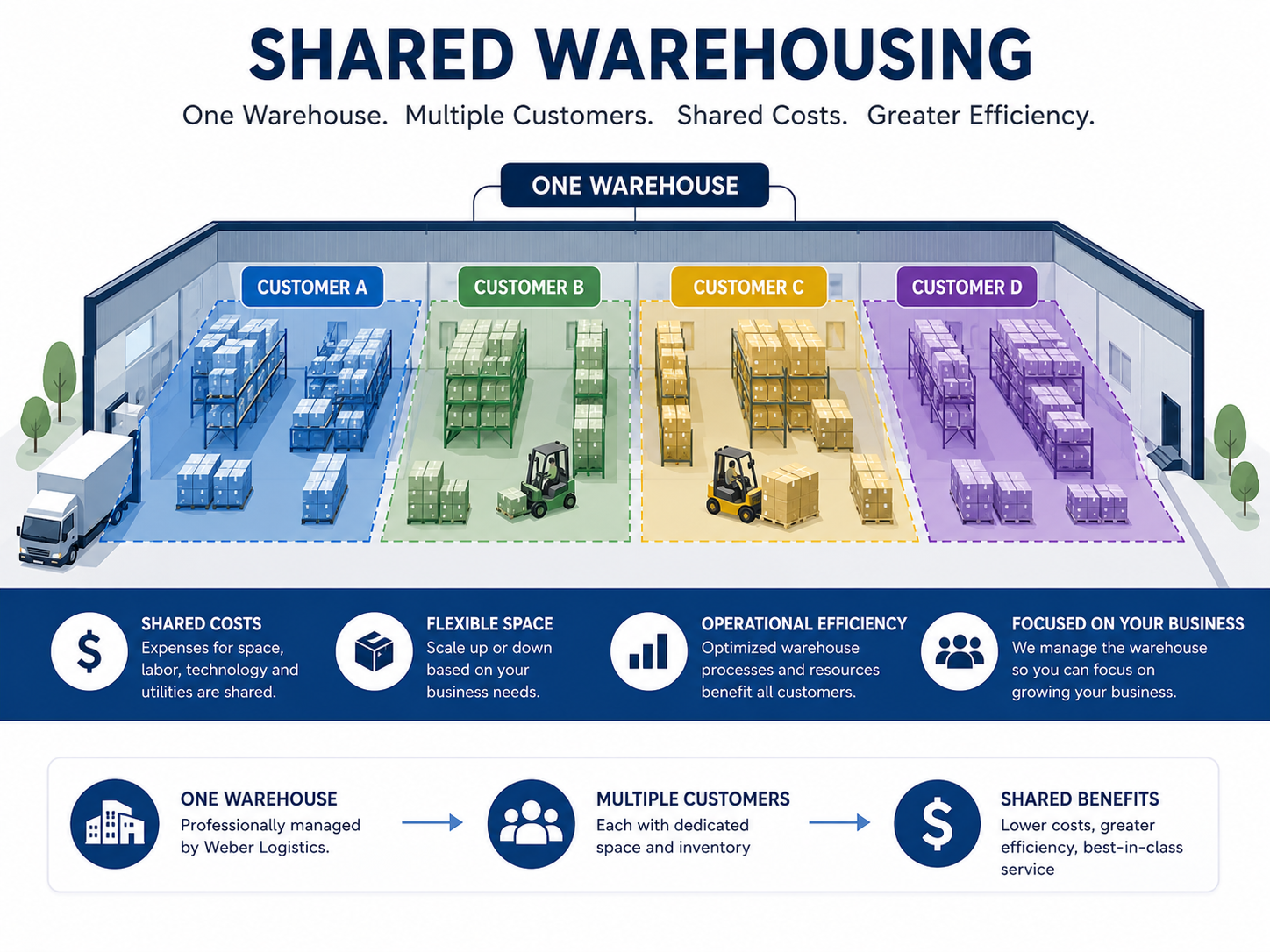
Shared warehousing (also known as public warehousing or multi-user facilities) flips this script. Instead of one company bearing 100% of the cost of a facility, multiple clients share the space, infrastructure, and management. This allows the 3PL provider to balance the peaks of one client with the valleys of another, creating a more stable and cost-efficient ecosystem for everyone involved.
Key Trends and Data Shaping the Move to Shared 3PL Models
The logistics industry is witnessing a structural shift. Recent industry analyses suggest that more than 60% of growing enterprises are now prioritizing “as-a-service” logistics models over traditional capital expenditures. Several factors are driving this trend:
- Conversion of CapEx to OpEx: Businesses are increasingly allergic to heavy capital expenditure (CapEx) on long-term warehouse leases. Shared warehousing allows these costs to become operational expenses (OpEx), scaling up or down based on actual usage.
- Inventory Optimization: With the rise of “Just-in-Case” inventory strategies (as opposed to “Just-in-Time”), companies need temporary overflow space. Shared facilities provide this “safety valve” during inventory builds.
- E-commerce Growth in Southeast Asia: Vietnam is one of the fastest-growing e-commerce markets. The nature of e-commerce—defined by flash sales and “double-day” promotions (11.11, 12.12)—requires warehouse space that can expand overnight and shrink just as fast.
- Global Supply Chain Diversification: As companies move production to Vietnam (the “China + 1” strategy), they often need trial warehousing setups before committing to permanent infrastructure.
Operational Impacts: Technology, Labor, and Flexibility
When you opt for Seasonal Volumes? 3PL Shared Warehousing Helps You Scale Without Overcommitting, you are not just buying a square meter of floor space; you are buying into an advanced operational system.
Advanced Technology Access
One of the primary barriers to efficient warehousing is the cost of a high-end Warehouse Management System (WMS). In a shared facility, the 3PL provider invests in top-tier technology that integrates with multiple ERP systems. Smaller or mid-sized companies get access to real-time tracking, automated picking algorithms, and sophisticated inventory reporting that they might not be able to afford independently.
Fluid Labor Management
Staffing a warehouse during a peak season is an HR nightmare. Recruiting, training, and then potentially laying off temporary workers is costly and risks low productivity. In a shared warehouse, the 3PL manages a core group of highly trained professionals. During a surge for a specific client, the 3PL can reallocate staff from a client currently in a “quiet” period. This cross-training ensures that the people handling your goods are professionals, not just temporary hires.
Value-Added Services (VAS)
Seasonal spikes often require more than just storage. They require kitting, labeling, gift-wrapping, or specialized packaging. Shared facilities are equipped to set up “pop-up” VAS stations. Because the infrastructure is already in place, the lead time to start these services is measured in days, not weeks.
Practical Lessons for Logistics Professionals
Transitioning to a shared warehousing model requires a shift in mindset. Here are best practices for managers looking to optimize their seasonal scaling:
- Focus on Data Accuracy: To scale effectively, your demand forecasting must be precise. Share your sales projections early with your 3PL partner so they can reserve space and labor in the shared environment.
- Verify Visibility: Ensure your 3PL provides a digital dashboard. In a shared environment, you need to be able to “see” your stock as clearly as if it were in your own building.
- Establish Clear SLAs: Service Level Agreements are vital. Define exactly how quickly orders must be processed during peak periods to ensure customer satisfaction isn’t sacrificed for cost savings.
- Strategic Location: Don’t just pick the cheapest warehouse. Pick a shared facility located near major transport hubs (like Cat Lai Port or Tan Son Nhat Airport) to reduce “last-mile” or “first-mile” transit times.
How Scanwell Logistics Vietnam Can Help
Scanwell Logistics Vietnam understands that your business is dynamic. We specialize in providing scalable warehousing solutions that grow alongside your ambitions. Our shared warehousing model is designed to provide the flexibility that Vietnamese manufacturers and international retailers need to thrive in a volatile market.
By partnering with Scanwell, you gain more than just space; you gain a strategic partner capable of integrating your warehousing with our global freight forwarding network. We manage the complexities of labor, security, and technology, leaving you free to focus on your core product and sales growth.
- Flexible Warehousing: Scalable space in key industrial zones across Vietnam.
- WMS Integration: Real-time inventory visibility and seamless data exchange.
- Integrated Freight: Smooth transitions from ocean or air freight directly into storage.
- Customs Excellence: Expert brokerage to ensure your seasonal imports and exports clear without delay.
- Distribution: Efficient domestic trucking to reach your final customers across Vietnam.
Conclusion
The old model of committing to massive, fixed logistics assets is becoming a liability. In today’s fast-paced environment, the ability to scale up and down is not just a convenience—it is a survival mechanism. Seasonal Volumes? 3PL Shared Warehousing Helps You Scale Without Overcommitting by transforming fixed costs into variable ones and providing access to world-class logistics infrastructure without the world-class price tag.
As we look toward the future of the Vietnamese supply chain, the winners will be those who remain agile. By leveraging the shared resources of a trusted 3PL like Scanwell Logistics, businesses can navigate the peaks of the peak season with confidence and the quiet of the off-season with financial stability.
Call to Action
Ready to turn these logistics insights into real competitive advantages?
Explore Scanwell Logistics Vietnam
Contact our experts for tailored support
FAQ
Is my inventory safe in a shared warehouse with other companies?
Absolutely. Professional 3PL providers like Scanwell use advanced WMS to ensure logical segregation of goods. Security protocols, including 24/7 monitoring and strict access controls, are applied to the entire facility, often providing better protection than a private, smaller-scale warehouse.
How quickly can I scale my space up during a peak?
While shared warehousing is flexible, it works best with communication. If you provide a forecast a few weeks in advance, the 3PL can almost always accommodate surges. The advantage is that you only pay for that extra space while you are using it.
Is shared warehousing more expensive per square meter?
While the base rate per meter might be slightly higher than a long-term shell lease, the *total cost of fulfillment* is usually much lower. You save on labor, equipment, utilities, insurance, and the cost of “empty space” during the off-season.
Can Scanwell handle specialized packaging during the Tet season?
Yes. We offer a variety of value-added services, including seasonal kitting, customized labeling, and promotional packaging, specifically designed to help brands meet the unique demands of the Vietnamese holiday market.