












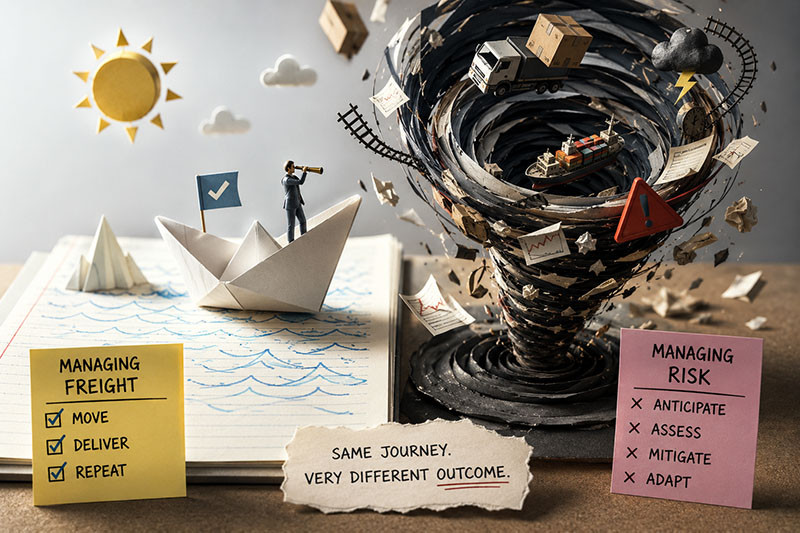
The Difference Between Managing Freight and Managing Risk
Estimated reading time: 8 minutes
In the fast-paced world of global commerce, the terms “freight management” and “risk management” are often used interchangeably, yet they represent two distinct pillars of a successful supply chain. For many businesses, the primary focus remains on the movement of goods—getting a container from a factory in Binh Duong to a warehouse in Long Beach. However, as global disruptions become the “new normal,” the industry is beginning to realize that moving cargo is only half the battle.
The Difference Between Managing Freight and Managing Risk lies in the transition from a reactive mindset to a proactive strategy. While freight management focuses on the logistics of transportation, execution, and cost-efficiency, risk management addresses the “what ifs.” It is the difference between booking a vessel and ensuring your business survives if that vessel is rerouted or delayed. For decision-makers in the Vietnamese market and beyond, understanding this nuance is critical for building supply chain resilience.
As we navigate an era of geopolitical shifts, climate-driven port delays, and fluctuating demand, this article explores why logistics managers must look beyond the bill of lading. We will analyze the core components of both disciplines, the impact of technology on visibility, and how a sophisticated approach to risk can actually lower your long-term ocean freight and air freight costs.
Table of Contents
- Defining the Core: Freight Management vs. Risk Management
- Key Trends: Why Risk is Now a Boardroom Priority
- The Operational Impact of a Risk-First Approach
- Practical Lessons for Logistics Professionals
- How Scanwell Logistics Vietnam Can Help
- Conclusion
- FAQ
Defining the Core: Freight Management vs. Risk Management
To understand The Difference Between Managing Freight and Managing Risk, we must first look at their individual objectives. Freight management is essentially the “operational” side of the house. It involves the selection of carriers, the negotiation of rates, and the coordination of freight forwarding activities. Its goal is efficiency: moving the maximum amount of product at the minimum cost in the shortest time.
In contrast, risk management is a “strategic” layer. It involves identifying, assessing, and prioritizing potential disruptions that could break the chain. While a freight manager asks, “What is the best rate for this ocean freight shipment?”, a risk manager asks, “What happens to our inventory if this specific port faces a strike, and do we have an alternative entry point?”
The Freight Management Scope
- Carrier Procurement: Vetting and selecting trucking, shipping, and air cargo partners.
- Route Optimization: Finding the most direct or cost-effective path for transit.
- Documentation: Managing BOLs, packing lists, and basic customs brokerage requirements.
- Tracking: Monitoring the milestone status of a shipment (e.g., “Departed Port,” “Arrived at Warehouse”).
The Risk Management Scope
- Contingency Planning: Developing “Plan B” and “Plan C” for every major trade lane.
- Insurance & Liability: Ensuring that the value of the goods is protected against cargo loss or damage.
- Compliance: Navigating complex international trade laws and risk mitigation in logistics to avoid heavy fines.
- Visibility: Using real-time data to predict delays before they happen, rather than just reacting to them.
Key Trends: Why Risk is Now a Boardroom Priority
Historically, risk was often treated as a secondary concern, hidden within the fine print of insurance policies. However, recent global events have shifted the spotlight. The vulnerability of lean, “just-in-time” supply chains has been exposed. Today, the conversation has shifted toward “just-in-case” models that prioritize supply chain resilience.
In Vietnam, as the country cements its role as a global manufacturing hub, the complexity of managing both freight and risk has scaled exponentially. Companies are no longer just shipping finished goods; they are managing intricate networks of raw materials coming in and finished products going out. This increases the surface area for potential risk.
- Geopolitical Volatility: Shifts in trade agreements and regional conflicts can instantly render a standard freight route unusable.
- Climate Impacts: Extreme weather events are increasing the frequency of force majeure declarations in ocean freight.
- Cybersecurity: As logistics becomes more digital, the risk of data breaches or ransomware shutting down a warehousing system is a growing threat.
- Inventory Bloat: To mitigate the risk of stockouts, many companies are over-ordering, which creates new risks related to capital tie-up and warehousing costs.
The Operational Impact of a Risk-First Approach
When a company begins to emphasize The Difference Between Managing Freight and Managing Risk, its daily operations change. Decisions are no longer made based solely on the lowest quote. Instead, “Total Landed Cost” and “Risk-Adjusted Cost” become the primary metrics.
For example, choosing a slightly more expensive air freight option might be seen as a “freight management” failure if only looking at the budget. However, if that choice prevents a factory shutdown due to a missing component, it is a massive “risk management” victory. This holistic view allows businesses to maintain customer trust even when the market is in turmoil.
Furthermore, managing risk requires a deeper level of partnership with freight forwarding providers. It moves the relationship from transactional (price-per-kilo) to consultative (strategic planning). This collaboration often leads to better data sharing, which improves overall tracking and visibility across the entire network.
Practical Lessons for Logistics Professionals
To effectively bridge the gap between execution and resilience, logistics and supply chain managers should adopt the following best practices:
- Diversify Your Carrier Base: Relying on a single carrier or a single port of entry is a high-risk strategy. Spread your volume across different alliances and transport modes.
- Invest in End-to-End Visibility: You cannot manage what you cannot see. Utilize platforms that provide real-time updates and predictive analytics to spot bottlenecks before they become crises.
- Audit Your Insurance Coverage: Standard carrier liability is often much lower than the actual value of your cargo. Ensure you have comprehensive cargo insurance that covers various risk scenarios.
- Regularly Stress-Test Your Supply Chain: Conduct “war games” or simulations. What happens if your main warehousing facility is inaccessible for 48 hours? Having a documented response plan is vital.
- Prioritize Communication: Establish clear communication protocols with your logistics partners. During a disruption, the speed of information is often more valuable than the speed of the cargo itself.
How Scanwell Logistics Vietnam Can Help
At Scanwell Logistics Vietnam, we understand that our clients aren’t just looking for someone to move boxes; they are looking for a partner to safeguard their business continuity. We specialize in navigating the complexities of the Vietnamese market while maintaining a global perspective on risk mitigation in logistics.
By leveraging our deep local expertise and our extensive global network, we provide a balanced approach that optimizes your freight costs without compromising on safety or reliability. Whether it’s rerouting cargo to avoid congestion or ensuring 100% compliance with evolving trade regulations, Scanwell acts as your strategic eyes and ears on the ground.
- Ocean Freight: Strategic FCL and LCL solutions with multiple carrier options to ensure capacity and minimize port-specific risks.
- Air Freight: Rapid response solutions for high-value or time-critical shipments that need to bypass traditional bottlenecks.
- Warehousing & Distribution: Secure storage and sophisticated inventory management to help you maintain safety stock in strategic locations.
- Domestic & Cross-Border Trucking: Reliable inland transport with real-time tracking to ensure the “last mile” is as secure as the first.
- Customs Brokerage: Expert guidance on Vietnamese and international trade compliance to eliminate the risk of delays and penalties.
Conclusion
Understanding The Difference Between Managing Freight and Managing Risk is no longer a luxury for large multinationals; it is a necessity for any business participating in the global economy. Freight management gets your product to market, but risk management ensures that your market existence isn’t threatened by the unpredictable.
As we look toward the future, the most successful logistics leaders will be those who can integrate these two disciplines. They will move away from the “lowest price” mentality and toward a “most resilient” strategy. By prioritizing visibility, diversification, and strategic partnerships, companies can turn logistics from a cost center into a powerful competitive advantage.
In the end, logistics is about more than just movement; it is about the confidence that your supply chain can withstand whatever the world throws at it. With the right approach and the right partners, managing risk becomes the ultimate way to manage freight.
Call to Action
Ready to turn these logistics insights into real competitive advantages?
Explore Scanwell Logistics Vietnam
Contact our experts for tailored support
FAQ
Does risk management always mean higher costs?
Not necessarily. While some risk mitigation strategies (like air freight or higher insurance) have upfront costs, they prevent catastrophic expenses like factory downtime, lost sales, or heavy fines. In the long run, risk management often leads to a lower Total Cost of Ownership.
How can small businesses start managing risk?
Start with visibility. Understand where your goods are at all times and identify the single points of failure in your supply chain (e.g., one specific supplier or one specific port). Partnering with a comprehensive freight forwarding provider like Scanwell can provide the technology and expertise that smaller teams may lack internally.
What is the most common risk in Vietnamese logistics today?
Currently, port congestion and fluctuating equipment availability (containers) are major concerns. Additionally, keeping up with changing customs brokerage regulations is a constant challenge for companies manufacturing in the region.
How does technology bridge the gap between freight and risk?
Technology provides the data needed to make risk-based decisions. AI-driven analytics can predict port delays days in advance, allowing freight managers to divert shipments before they get stuck, effectively merging execution with foresight.