

















How Decision Latency Costs More Than Freight Rates
Estimated reading time: 9 minutes
In the fast-paced world of global trade, supply chain managers often find themselves fixated on a single metric: the freight rate. Whether it is the cost of a 40-foot container from Ho Chi Minh City to Long Beach or the per-kilogram price of air cargo from Hanoi to Frankfurt, the focus is almost always on procurement costs. However, a growing body of evidence suggests that many organizations are looking at the wrong ledger. While freight rates are visible and easily debated, a silent killer is eroding profit margins behind the scenes: decision latency.
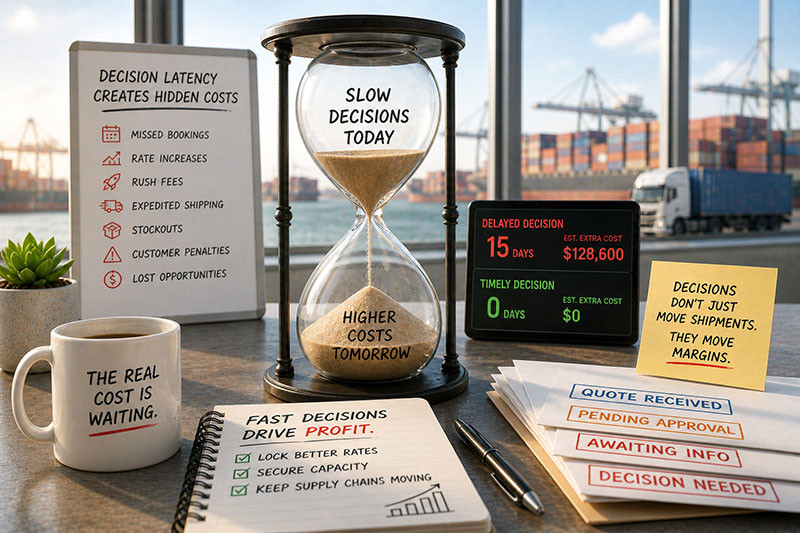
How Decision Latency Costs More Than Freight Rates is a concept that challenges traditional logistics thinking. Decision latency refers to the time elapsed between a signal appearing—such as a sudden drop in inventory or a port congestion warning—and the organization’s actual response to that signal. In an era where supply chains are increasingly volatile, the “wait-and-see” approach is no longer a neutral stance; it is an expensive liability. For businesses operating in Vietnam’s manufacturing and export hub, understanding this dynamic is the difference between a resilient supply chain and one that is constantly in crisis mode.
This article explores the mechanics of decision latency, the hidden costs of emergency freight, and how modern technology can bridge the gap between information and action. We will analyze why the speed of your decision-making often dictates your logistics budget far more than the market price of transportation ever could.
Table of Contents
- Understanding the Concept: What is Decision Latency?
- The Hidden Math: How Decision Latency Costs More Than Freight Rates
- The Data Connection: Lead Times and Performance
- Operational Impacts on Supply Chain Resilience
- Practical Lessons for Logistics Professionals
- How Scanwell Logistics Vietnam can help
- Conclusion
- FAQ
Understanding the Concept: What is Decision Latency?
At its core, decision latency is the “lag” in your operational nervous system. In any logistics environment, signals are constantly being generated. A vessel might be delayed by a storm, a factory might report a production shortfall, or a retail outlet might see an unexpected surge in demand. These are the “signals.” The latency period begins the moment the signal is available and ends when a corrective action is executed—such as re-routing a shipment, increasing an order, or switching transport modes.
In many organizations, this process is hindered by bureaucratic hurdles, siloed data, and manual reporting. A logistics manager might see a stockout risk on a Monday, but by the time they gather approvals from finance, procurement, and operations, it is Friday. That five-day gap is the decision latency. During those five days, the options available to the company narrow significantly, and the costs begin to skyrocket.
Logistics experts often categorize decision latency into three distinct phases:
- Data Latency: The time it takes for the signal to be captured and made available to the decision-maker.
- Analysis Latency: The time required to understand the data and determine the necessary course of action.
- Action Latency: The time it takes to actually implement the decision within the supply chain network.
The Hidden Math: How Decision Latency Costs More Than Freight Rates
When freight rates fluctuate, companies often spend weeks negotiating with carriers to shave off a few dollars per container. While this is important, it often pales in comparison to the costs generated by delayed decisions. According to research from the Supply Chain Management Review, the most expensive freight is almost always “emergency freight.”
Emergency freight spend is not a standard logistics cost; it is a symptom of poor decision-making. When a company fails to respond promptly to a shortage, they are eventually forced to rush shipments to avoid stockouts or factory shutdowns. This usually means moving cargo from ocean freight to expensive air freight or paying extreme premiums for “guaranteed” space on a vessel. In these scenarios, the “freight rate” paid is often 5 to 10 times the original planned cost.
The Cost of Lost Opportunity
The financial impact goes beyond transportation. Decision latency leads to:
- Stockouts: Every day a product is not on the shelf is a day of lost revenue that can never be recovered.
- Damaged Relationships: Persistent delays erode trust with B2B partners and end consumers alike.
- Inventory Imbalances: Slow decisions often lead to “panic buying,” resulting in excess inventory and high carrying costs once the crisis passes.
Ultimately, while freight rates are determined by market forces, decision latency is an internal cost that companies have the power to control. Failing to do so can, in extreme cases, lead to business failure or even bankruptcy.
Key Trends and Data: The Impact of Time
Research has consistently shown that the speed of the supply chain is directly correlated with its cost-efficiency. According to studies referenced in Inbound Logistics, reducing lead times—the total time from order to delivery—has a transformative effect on the bottom line.
- The 1-Day Rule: Reducing lead times by just one single day can save an organization up to 20% on total transportation costs. This is achieved by allowing for more economical shipping choices and reducing the need for safety stock.
- Automation Gains: Companies that automate their decision-making processes through AI and machine learning report significantly lower latency and higher supply chain resilience.
- Market Volatility: In the current global climate, where disruptions are the “new normal,” the ability to act instantly on data is a massive competitive advantage.
These data points highlight that the “Silent Killer” of logistics performance isn’t the price of fuel or the lack of containers; it is the time lost between knowing there is a problem and doing something about it.
Operational Impacts on Supply Chain Resilience
Supply chain resilience is the ability of a network to withstand or recover quickly from difficulties. High decision latency is the antithesis of resilience. When an organization is slow to react, it loses the “buffer” time required to find creative solutions.
For example, if a port strike is predicted in two weeks, a low-latency organization might immediately re-route goods to a different port via ocean freight. A high-latency organization might wait until the strike actually starts before discussing their options. By then, the only solution left is air freight—costing hundreds of thousands of dollars more.
The consequences of this lag affect every department:
- Warehousing: Unexpected arrivals of emergency freight disrupt warehouse scheduling and labor planning.
- Compliance: Rushed decisions can lead to errors in documentation and customs declarations, resulting in fines or further delays.
- Customer Satisfaction: In the age of “Amazon-prime” expectations, consumers have little patience for delays caused by internal administrative lag.
Practical Lessons for Logistics Professionals
To combat the costs associated with decision latency, logistics and supply chain leaders must shift their focus from reactive firefighting to proactive, data-driven management. Here are several best practices to consider:
- Invest in Real-Time Visibility: You cannot decide on what you cannot see. Utilize IoT and advanced tracking to monitor shipments and inventory levels in real-time.
- Streamline Approval Workflows: Empower logistics managers to make decisions within certain budget thresholds without needing multi-level executive sign-offs for every change.
- Collaborate with Partners: Work closely with your freight forwarder to receive early warning signals about market shifts, port conditions, and capacity constraints.
- Leverage AI and Machine Learning: Use predictive analytics to anticipate disruptions before they happen, allowing for “pre-decisions” that minimize future latency.
- Standardize Response Protocols: Develop “if-then” scenarios. If a lead time increases by X days, then automatically trigger shipment via Y carrier.
How Scanwell Logistics Vietnam Can Help
At Scanwell Logistics Vietnam, we understand that in the modern supply chain, information is just as valuable as the cargo itself. We help our clients move beyond the narrow focus of freight rates by providing the tools and expertise needed to eliminate decision latency. Our local presence in Vietnam, combined with our global network, ensures that you receive accurate, real-time signals from the ground.
We assist business leaders in navigating the complexities of international trade by acting as an extension of their decision-making team. By providing high-visibility tracking and proactive communication, we ensure that you have the data you need to act before a situation becomes an emergency.
- Ocean Freight: Reliable FCL and LCL services with multiple carrier options to ensure flexibility when plans change.
- Air Freight Solutions: Rapid response for time-sensitive cargo, managed with precision to minimize emergency spend.
- Warehousing & Distribution: Strategic storage solutions in Vietnam to help manage inventory buffers and reduce stockout risks.
- Domestic Trucking: Seamless connection between ports, factories, and warehouses to keep the supply chain moving.
- Customs Brokerage: Expert compliance support to ensure that fast decisions don’t lead to regulatory delays.
Conclusion
The logistics industry is evolving. While the cost of a container will always be a factor in the budget, it is no longer the primary driver of supply chain success. As we have seen, how decision latency costs more than freight rates is a reality that every modern business must confront. The “silent killer” of performance—the time between signal and action—can deplete reserves, damage reputations, and stifle growth.
To stay competitive, especially in a dynamic market like Vietnam, companies must prioritize agility over pure procurement savings. By reducing lead times, embracing automation, and investing in real-time visibility, organizations can transform their logistics from a cost center into a strategic advantage.
The goal is simple: see faster, decide faster, and act faster. When you master the speed of your decisions, the freight rates take care of themselves.
Call to Action
Ready to turn these logistics insights into real competitive advantages?
Explore Scanwell Logistics Vietnam
Contact our experts for tailored support
FAQ
Why exactly is decision latency more expensive than freight rates?
While freight rates might fluctuate by 10-20%, decision latency can lead to “emergency freight” costs that are 500% higher than standard rates. Furthermore, it causes stockouts and lost sales, which represent a total loss of revenue that cannot be recovered by lower shipping prices.
How can technology like AI help reduce this latency?
AI can process vast amounts of supply chain data much faster than a human team. It can identify patterns—like a recurring delay at a specific port—and suggest alternative routes or trigger automated re-orders, cutting analysis and action latency to almost zero.
Is a one-day reduction in lead time really that significant?
Yes. Research indicates that a one-day reduction in lead time can correlate with up to 20% savings in transportation costs. This happens because shorter lead times reduce the need for expensive safety stock and allow for more predictable, scheduled transport instead of last-minute rushes.
How does working with a partner like Scanwell reduce decision latency?
Scanwell provides real-time visibility and expert local knowledge. By giving you immediate access to accurate data and professional advice, we reduce the “Data Latency” and “Analysis Latency” phases, allowing your team to make informed decisions faster and avoid costly emergency shipping scenarios.