
















The Hidden Trade-Off Between Shipping Speed, Cost, and Customer Trust (With Real Numbers)
Estimated reading time: 9 minutes
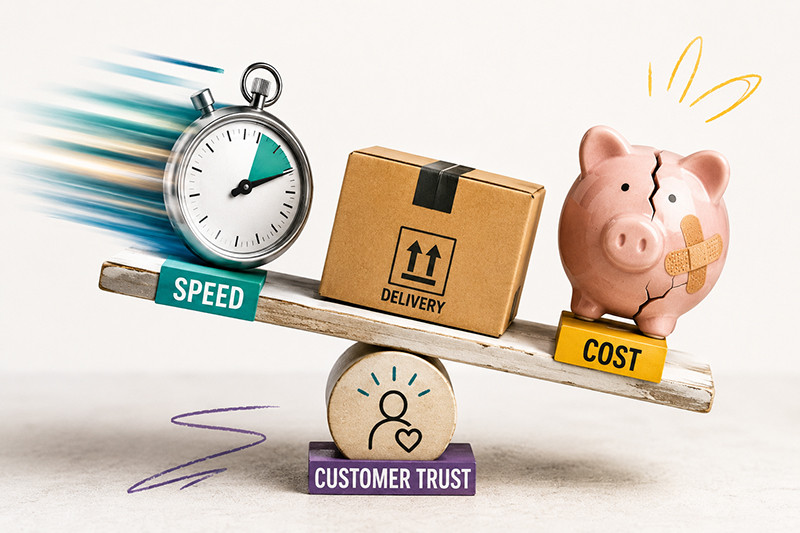
In the modern era of global commerce, the “Amazon Effect” has redefined consumer expectations. For businesses operating in or out of hubs like Vietnam, the pressure to deliver products faster than ever is relentless. However, behind every “Next Day Delivery” button lies a complex web of logistics decisions that force a difficult choice. This is known as the logistics trilemma: the delicate balance between The Hidden Trade-Off Between Shipping Speed, Cost, and Customer Trust (With Real Numbers).
For supply chain managers and e-commerce leaders, the temptation to prioritize speed is high. Speed is a visible, marketable metric. Yet, as research into e-commerce logistics suggests, achieving peak performance in speed, cost-efficiency, and customer satisfaction simultaneously is often impossible at scale without massive capital investment. This article explores why these three pillars often work against one another and how businesses can navigate these trade-offs to build a sustainable, trustworthy brand.
Table of Contents
- The Iron Triangle: Speed, Cost, and Trust
- The High Price of Velocity: Why Speed Impacts the Bottom Line
- The Trust Gap: When Speed Promises Fail
- Practical Lessons for Logistics Professionals
- How Scanwell Logistics Vietnam Can Help
- Conclusion
- FAQ
The Iron Triangle: Speed, Cost, and Trust
In logistics, the “Iron Triangle” suggests that you can have it fast, you can have it cheap, or you can have it reliable—but rarely all three at once. When we discuss The Hidden Trade-Off Between Shipping Speed, Cost, and Customer Trust (With Real Numbers), we are looking at how these variables interact in a real-world supply chain environment.
Speed is the most visible metric to the customer. When an order is placed, the countdown begins. For the logistics provider, speed requires premium transportation modes (like air freight over ocean freight) and decentralized warehousing (keeping stock closer to the end user). Both of these requirements drive up the “Cost” side of the triangle.
Customer trust, the third and often most fragile pillar, is built on the consistency of the experience. It is not just about being fast; it is about being accurate. If a brand promises two-day shipping to win a sale but takes four days due to a strained supply chain, the speed metric might still be “fast” by historical standards, but the trust is broken.
The High Price of Velocity: Why Speed Impacts the Bottom Line
Prioritizing shipping speed is a strategic move, but it comes with significant financial implications. Research indicates that e-commerce brands often struggle to maintain profitability when they over-index on speed. Here is how those costs manifest:
Premium Freight Modes
To shave days off a delivery schedule, businesses often must pivot from sea to air. For a shipment leaving Vietnam for the United States, ocean freight is exponentially cheaper but can take 30–40 days. Air freight reduces this to 3–5 days but can cost 5 to 10 times more per kilogram. This direct hit to the margin is the most obvious “hidden” cost of speed.
Inventory Fragmentation
To achieve “last-mile” speed, inventory must be positioned in multiple warehouses across a region. Instead of one central hub in Ho Chi Minh City, a business might need nodes in Da Nang and Hanoi, or even international micro-fulfillment centers.
- Increased Carrying Costs: More warehouses mean more safety stock held in more places.
- Inbound Logistics: Higher costs to distribute products from the factory to multiple warehouse locations.
- Management Overhead: Complex software and more personnel are needed to manage a fragmented network.
The Trust Gap: When Speed Promises Fail
While speed is a powerful marketing tool, it can be a “double-edged sword” for customer trust. When a brand prioritizes speed at the expense of operational stability, the likelihood of errors increases. These errors are the primary killers of customer retention.
According to logistics research, customers value reliability over speed. A customer is generally happier with a 5-day delivery that arrives on day five than a 2-day delivery that arrives on day three. The reason? Expectation management.
When businesses push their logistics networks to the absolute limit to meet aggressive speed targets, several things happen that can compromise trust:
- Increased Damage Rates: Faster handling in warehouses and more “touches” during rapid transit increase the risk of goods arriving damaged.
- Poor Visibility: In the rush to ship, tracking data may lag, leaving customers in the dark.
- Compliance Risks: Rushing through customs documentation can lead to audits or delays at the border, ironically slowing down the “fast” shipment.
Practical Lessons for Logistics Professionals
To navigate The Hidden Trade-Off Between Shipping Speed, Cost, and Customer Trust, logistics leaders should adopt a more nuanced strategy than simply “going faster.” Here are several best practices:
- Segment Your Customers: Not every customer needs “Next Day” delivery. Offer tiered shipping options that allow customers to choose between speed and cost. This empowers the buyer and protects your margins.
- Optimize Inventory Placement: Use data analytics to predict where demand will be. Instead of moving everything fast, move the right items close to the customer before they even order.
- Invest in Visibility Technology: Trust is built on transparency. Even if a shipment is slow, providing real-time tracking and proactive delay notifications can maintain customer satisfaction.
- Diversify Carrier Portfolios: Relying on a single carrier for speed is risky. Having a mix of postal services, express couriers, and regional trucking partners provides a “safety valve” during peak seasons.
How Scanwell Logistics Vietnam Can Help
At Scanwell Logistics Vietnam, we understand that “fast” isn’t always “best.” We work with business leaders to design supply chain solutions that respect the balance of speed, cost, and trust. Our deep roots in the Vietnamese market, combined with a global network, allow us to offer flexible options that mitigate the risks of this trade-off.
Whether you are an e-commerce brand looking to optimize your last-mile delivery in Southeast Asia or a manufacturer needing to move bulk cargo to the US, we provide the data and the infrastructure to help you make informed decisions.
- Ocean Freight: Cost-effective FCL and LCL solutions for when cost takes priority over speed.
- Air Freight: Rapid transit for high-value or time-sensitive cargo.
- Warehousing & Distribution: Strategic storage in Vietnam and beyond to bring products closer to your customers.
- Customs Brokerage: Ensuring compliance so that “speed” doesn’t get stuck at the border.
- Supply Chain Visibility: Advanced tracking tools to ensure customer trust is maintained through every mile.
Conclusion
The logistics landscape is no longer just about moving boxes; it is about managing expectations. The Hidden Trade-Off Between Shipping Speed, Cost, and Customer Trust (With Real Numbers) reveals that while speed is a competitive advantage, it is not a silver bullet. Over-prioritizing velocity can lead to ballooning costs and, more dangerously, a breakdown in customer loyalty if those promises are not met.
Logistics leaders must look beyond the visible metrics. By focusing on reliability, inventory optimization, and transparent communication, businesses can build a supply chain that is not just fast, but sustainable and trustworthy. The goal is to create a “Goldilocks” zone—where shipping is fast enough to delight, cost-effective enough to profit, and reliable enough to keep customers coming back.
Call to Action
Ready to turn these logistics insights into real competitive advantages?
Explore Scanwell Logistics Vietnam
Contact our experts for tailored support
FAQ
Why is speed often considered the most important logistics metric?
Speed is highly visible and easy for consumers to compare. Brands use it as a primary marketing tool to differentiate themselves, even if the underlying cost makes it difficult to sustain at scale.
How does prioritizing speed hurt customer trust?
If a brand promises extreme speed but lacks the operational infrastructure to deliver, it leads to missed deadlines and poor communication. Trust is built on consistency, and pushing for speed often leads to inconsistency.
Can technology help bridge the gap between cost and speed?
Yes. Predictive analytics and AI can help businesses position inventory closer to demand centers, allowing for faster local delivery without the need for expensive cross-border air freight for every individual order.
How can Scanwell Logistics Vietnam help my business find the right balance?
We analyze your specific supply chain needs—considering your margins, customer locations, and product types—to design a multimodal strategy that provides the best mix of air, sea, and road transport coupled with strategic warehousing.