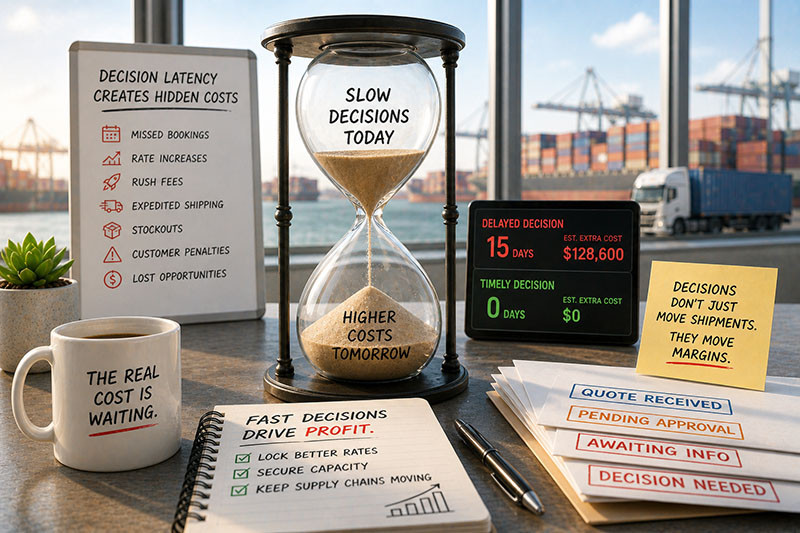
How Decision Latency Costs More Than Freight Rates
Estimated reading time: 9 minutes
In the high-stakes world of global supply chains, there is a particular type of optimism that often surfaces during Monday morning logistics meetings. It usually sounds like this: “Let’s just wait one more day. We’ll have more data by tomorrow.” On the surface, this sounds like prudent management—a careful approach to avoid unnecessary risks. However, in reality, it is often a symptom of a much deeper, more expensive problem: decision latency.
Decision latency is the gap between a signal appearing (a port strike, a sudden demand spike, or a supplier delay) and your organization actually taking action. While most managers obsess over fluctuating freight rates, they often ignore the silent drain of delayed decisions. As we will explore, How Decision Latency Costs More Than Freight Rates is not just a theoretical concept; it is a hard reality that impacts the bottom line of businesses across Vietnam and the globe. When a leak is discovered, waiting for more data before turning off the tap only ensures that the eventual flood will be more destructive.
For logistics leaders and supply chain managers, understanding the hidden mechanics of decision latency is the first step toward building a truly resilient operation. This article analyzes why the “silent” costs of delay are far more damaging than the “loud” costs of shipping, and how you can pivot your strategy to prioritize speed and agility in an increasingly volatile market.
Table of Contents
- The Anatomy of Decision Latency vs. Freight Rates
- The Hidden Financial and Reputational Toll
- Root Causes: Why Logistics Organizations Hesitate
- Operational Impacts on Global Supply Chains
- Practical Lessons for Logistics Professionals
- How Scanwell Logistics Vietnam Can Help
- Conclusion
- FAQ
The Anatomy of Decision Latency vs. Freight Rates
In logistics procurement, freight rates are “loud.” They appear in bold numbers on invoices, they are the subject of intense quarterly negotiations, and they are frequently used as the primary KPI for logistics departments. Because they are visible and quantifiable, they receive the lion’s share of executive attention. However, focusing solely on the rate per container is a narrow view of supply chain health.
Decision latency, by contrast, is silent. It doesn’t have a dedicated line item on a profit and loss statement, yet its fingerprints are everywhere. It is the time lost between recognizing a disruption and executing a contingency plan. While you are waiting for “better data” to save a few hundred dollars on a spot rate, the window for securing alternative capacity may close, or your inventory may run dry, leading to a much larger loss in total landed cost.
Defining the Latency Gap
Think of decision latency as a three-stage process:
- Analysis Latency: The time it takes to understand what the data is telling you.
- Decision Latency: The time it takes to decide on a course of action once the situation is understood.
- Action Latency: The time it takes to implement that decision within the supply chain.
In the logistics context, these delays compound. A one-day delay in deciding to reroute a shipment can result in a two-week delay at a congested port, as other more agile competitors snap up the remaining slots. This demonstrates how decision latency costs more than freight rates—the rate might remain the same, but the cost of the delay to the business is exponential.
The Hidden Financial and Reputational Toll
The consequences of decision latency extend far beyond a single delayed shipment. It acts as a corrosive force on a company’s competitive standing and financial stability.
Direct Revenue and Opportunity Loss
When a company hesitates to adjust its logistics strategy in response to market changes, it risks missing out on “golden opportunities.” This could mean being unable to fulfill a sudden surge in e-commerce demand or failing to restock a popular product during a peak season. The revenue lost from an out-of-stock item is often significantly higher than any potential savings gained from waiting for a lower freight rate.
Erosion of Trust and Reputation
In today’s hyper-connected market, customers expect transparency and speed. Decision latency leads to inconsistent delivery times and broken promises. If a logistics manager recognizes a bottleneck but waits too long to communicate or pivot, the end customer bears the brunt of the failure. Over time, this erodes the company’s reputation, making it harder to retain high-value clients who prioritize reliability over the lowest possible shipping cost.
The Impact on Innovation
A culture that tolerates high decision latency is rarely an innovative one. When speed is not prioritized, the organization becomes reactive rather than proactive. Companies that are slow to respond to changes in the market risk falling behind and losing their competitive edge, as they are essentially operating on yesterday’s information while their competitors are already planning for tomorrow.
Root Causes: Why Logistics Organizations Hesitate
If the costs are so high, why do companies continue to fall into the trap of decision latency? The research suggests several core factors that contribute to this organizational “paralysis.”
- Inadequate Decision-Making Processes: Many companies have bureaucratic layers that require multiple sign-offs for even minor adjustments. By the time a decision reaches the executive level, the market conditions have already shifted.
- Lack of Actionable Data: While we often talk about “big data,” many logistics teams suffer from “dirty data” or fragmented information. Without a single source of truth, teams spend more time arguing about the accuracy of the data than taking action on it.
- Poor Communication: Silos between the procurement, logistics, and sales departments mean that signals are often lost in translation. A signal that is vital to the warehouse may never reach the transportation desk until it is too late.
- A Culture of Complacency: Often, there is a “status quo” bias. Employees may feel comfortable with existing processes and are reluctant to “rock the boat” by suggesting a radical shift in strategy, even when the data suggests it is necessary.
Operational Impacts on Global Supply Chains
In the specific context of logistics, decision latency manifests in ways that can cripple daily operations. With the rise of e-commerce and the increasing complexity of global supply chains, the margin for error has narrowed significantly.
Consider the impact on warehousing and distribution. If a decision to increase safety stock is delayed because of a debate over carrying costs, a minor disruption in the shipping lane can lead to a complete stockout. Conversely, delaying a decision to clear out slow-moving inventory can lead to a “gridlocked” warehouse, where the lack of space prevents the intake of high-demand goods.
In freight forwarding, decision latency can result in lost cargo space. During peak seasons, carrier capacity is a dwindling resource. A company that waits even a few hours to confirm a booking may find themselves “rolled” to the next vessel, potentially delaying a project by weeks. This is a primary example of how decision latency costs more than freight rates; the price of the container becomes irrelevant if the container never leaves the dock.
Practical Lessons for Logistics Professionals
To mitigate the effects of decision latency, companies must transition from a culture of “waiting for certainty” to a culture of “informed urgency.” Here are practical steps to reduce the latency gap:
- Empower the Front Line: Decentralize decision-making. Empower logistics managers to make tactical decisions (like rerouting a shipment or choosing an alternative carrier) without needing to escalate every move to upper management.
- Invest in Real-Time Visibility: Use technology that provides a clear, real-time signal. When you can see a delay happening in real-time, the “analysis latency” is shortened, allowing for faster decision-making.
- Standardize Contingency Plans: Don’t wait for a crisis to decide what to do. Create “if-then” scenarios. If Port A is congested by X%, then we automatically divert to Port B. This removes the hesitation from the process.
- Prioritize Agility Over Perfection: In a volatile market, a “good” decision made today is often better than a “perfect” decision made next week. Aim for speed and the ability to course-correct quickly.
How Scanwell Logistics Vietnam Can Help
At Scanwell Logistics Vietnam, we understand that time is the most valuable commodity in your supply chain. We don’t just move boxes; we provide the clarity and speed necessary to overcome the hidden costs of decision latency. Our regional expertise and technology-driven approach ensure that our clients are always one step ahead of market disruptions.
By partnering with Scanwell, you gain access to a network that prioritizes proactive communication. We identify potential “signals” in the global trade environment before they become “floods,” allowing you to take action while your competitors are still analyzing the data. Whether it’s navigating complex customs regulations or securing space on a tight air freight schedule, our goal is to minimize your latency and maximize your competitive advantage.
- Ocean Freight: Strategic FCL and LCL planning to bypass congestion and reduce idle time.
- Air Freight: Rapid-response solutions for when decision latency has already put your schedule at risk.
- Warehousing & Distribution: Agile inventory management that adapts to changing demand signals.
- Customs Brokerage: Streamlined compliance to ensure that documentation issues never cause a decision delay.
- End-to-End Visibility: Technology that turns raw data into actionable insights for faster decision-making.
Conclusion
In the modern logistics landscape, the phrase “wait and see” is often the most expensive strategy a company can employ. While freight rates will always fluctuate and demand our attention, it is the silent, internal delay of decision-making that truly threatens the health of a supply chain. Decision latency leads to lost revenue, damaged customer relationships, and a gradual decline in market competitiveness.
To succeed, logistics leaders must foster a culture of urgency, invest in visibility, and empower their teams to act on signals quickly. By recognizing that How Decision Latency Costs More Than Freight Rates is a fundamental rule of logistics, businesses can pivot from being reactive victims of the market to being proactive leaders. The “tap” is within your reach—don’t wait for the flood to turn it off.
Call to Action
Ready to eliminate decision latency and secure your supply chain?
Explore Scanwell Logistics Vietnam’s Agile Solutions
Contact our experts to speed up your logistics today
FAQ
Why is decision latency considered “silent” compared to freight rates?
Freight rates are explicit costs that appear on invoices and contracts, making them easy to track and debate. Decision latency is an opportunity cost—it’s the money you don’t make and the efficiency you lose, which doesn’t always show up as a single line item, but impacts overall profitability deeply.
How can a small business reduce decision latency without expensive software?
Start with culture and process. Streamline who has the authority to make shipping decisions and create clear communication channels between your sales and logistics teams. Reducing the number of people who need to “approve” a standard rerouting can save days of delay.
Does prioritizing speed mean taking unnecessary risks?
Not necessarily. Prioritizing speed means acting on the best available information rather than waiting for 100% certainty, which rarely exists in logistics. It’s about being “decisively agile”—making a move and being ready to course-correct if the situation changes.
How does Scanwell Logistics help in reducing the decision-making gap?
We provide real-time updates and expert local insights that act as a “signal” for our clients. By giving you accurate information sooner and offering pre-planned logistics alternatives, we help you bridge the gap between recognizing a problem and solving it.