












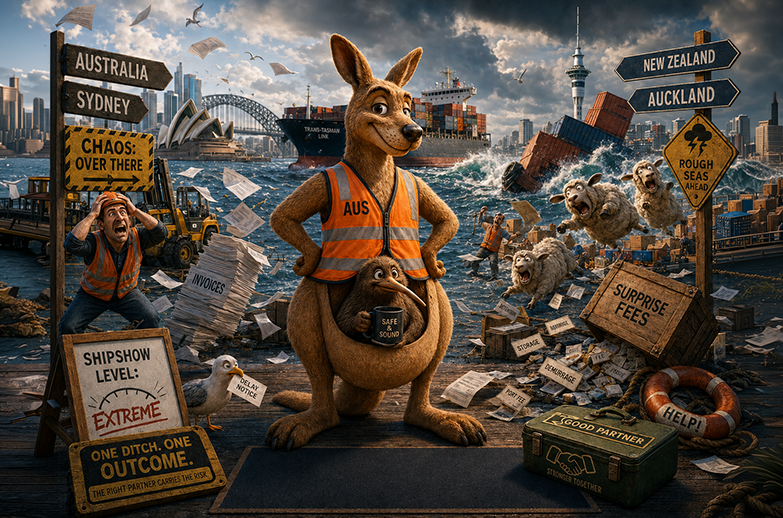
How to Choose a Trans-Tasman Freight Partner: The 12 Questions to Ask Before the Cheap Quote Starts Eating Your Margin
Estimated reading time: 9 minutes
In the high-stakes world of international trade, the “Trans-Tasman” route—the shipping lane connecting Australia and New Zealand—is often perceived as one of the most straightforward. Because of the close economic ties and geographical proximity between these two nations, many businesses fall into the trap of commoditizing their logistics. They prioritize the lowest possible quote, assuming that the short distance equates to low risk. However, as any seasoned supply chain manager knows, every freight provider looks brilliant when the freight behaves.
The true test of a logistics provider isn’t the smooth sailing; it’s the emergency situations, the port strikes, the biosecurity delays, and the sudden capacity crunches. For businesses operating in this space, How to Choose a Trans-Tasman Freight Partner: The 12 Questions to Ask Before the Cheap Quote Starts Eating Your Margin is not just a strategic consideration—it is a necessity for protecting your bottom line. A “cheap” quote that results in a two-week delay at customs or an unexpected fuel surcharge can quickly turn a profitable shipment into a financial loss.
This guide provides a comprehensive framework for evaluating potential partners. We will dive deep into the twelve critical questions you must ask to ensure your logistics provider has the experience, infrastructure, and transparency required to navigate the unique challenges of the logistics industry across the Tasman Sea.
Table of Contents
- Why the Trans-Tasman Route Requires Specialized Expertise
- The 12 Essential Questions for Your Freight Partner
- The Hidden Costs of Choosing the Wrong Partner
- Practical Lessons for Logistics Professionals
- How Scanwell Logistics Vietnam Can Help
- Conclusion
- FAQ
Why the Trans-Tasman Route Requires Specialized Expertise
The Trans-Tasman trade lane is a vital artery for businesses in Oceania, but it is far from a domestic hop. Despite the Closer Economic Relations (CER) agreement, Australia and New Zealand remain two distinct sovereign nations with rigorous biosecurity laws, different customs regulations, and unique port infrastructures.
In the logistics industry, the Trans-Tasman route is often subject to volatile weather patterns in the Tasman Sea, which can disrupt ocean freight schedules. Furthermore, air cargo capacity can fluctuate based on tourism trends and passenger flight availability. A partner who treats this route as an afterthought—rather than a specialized service—is likely to lack the contingency plans necessary when things go wrong.
Choosing a partner requires moving beyond the surface-level price. You need to understand their operational depth. Are they merely a broker moving paper, or do they have “boots on the ground” and established relationships with local carriers in Sydney, Melbourne, Auckland, and Christchurch? This distinction determines whether your cargo gets priority or sits in a warehouse waiting for a cheaper, slower slot.
The 12 Essential Questions for Your Freight Partner
To protect your margins, you must vet your provider thoroughly. Use these twelve questions as your checklist during the RFP (Request for Proposal) process.
Category A: Experience and Reliability
-
1. What experience do you have with Trans-Tasman freight?
Longevity in this specific lane matters. Ask for case studies or examples of how they have handled complex shipments between AU and NZ. -
2. What is your average transit time for Trans-Tasman freight?
Compare their “door-to-door” estimates rather than just “port-to-port.” This reveals their efficiency in local pick-up and delivery. -
3. What is your track record for on-time delivery for Trans-Tasman freight?
Reliability is measured in data. Ask for their On-Time Performance (OTP) percentages over the last 12 months. -
4. Do you have any certifications or accreditations for Trans-Tasman freight?
Look for industry-standard certifications that prove they adhere to global best practices and local safety regulations.
Category B: Financial Transparency
-
5. What is your rate structure for Trans-Tasman freight?
Is it a flat rate, or are there tiered pricing models? Ensure you understand exactly what the base rate covers. -
6. What is your fuel surcharge policy for Trans-Tasman freight?
Fuel is a massive variable. A partner with an opaque fuel surcharge policy can inflate your costs significantly without warning. -
7. Do you have any discounts or promotions for Trans-Tasman freight?
Volume-based discounts or seasonal promotions can help improve your logistics operations efficiency and reduce costs.
Category C: Operational Execution
-
8. How do you handle customs clearance for Trans-Tasman freight?
Both countries have strict biosecurity rules. A partner who understands the specific requirements for wood packaging, chemicals, or food products can prevent costly seizures. -
9. Do you have any partnerships or agreements with local carriers for Trans-Tasman freight?
The “last mile” is often the most expensive. Local partnerships ensure your cargo moves quickly once it hits the dock. -
10. What is your process for monitoring and managing cargo for Trans-Tasman freight?
Real-time visibility is no longer a luxury; it’s a requirement. Ask about their tracking platforms and communication protocols.
Category D: Risk and Dispute Management
-
11. What is your policy for liability and insurance for Trans-Tasman freight?
Don’t assume your cargo is fully covered. Understand the limits of their liability and the cost of supplemental insurance. -
12. How do you handle claims or disputes for Trans-Tasman freight?
When damage or loss occurs, you need a clear, documented process for resolution. A slow claims process is a major red flag.
The Hidden Costs of Choosing the Wrong Partner
The most dangerous phrase in the logistics industry is “I found a cheaper quote.” While cost reduction is a valid goal for any supply chain manager, the headline rate is rarely the final price. An unreliable partner can introduce a range of “hidden costs” that quickly erode your profit margins.
Consider the impact of poor customs clearance expertise. If a freight forwarder fails to properly advise on biosecurity documentation for a shipment to New Zealand, the cargo may be held for cleaning or inspection. The resulting storage fees (demurrage) and late delivery penalties from your customers can easily dwarf the $200 you saved on the initial shipping quote.
Furthermore, long transit times lead to higher carrying costs for inventory. If your Trans-Tasman freight partner consistently misses their windows, you are forced to hold more safety stock in your warehouses, tying up capital that could be used elsewhere. Efficiency in logistics operations is about the total cost of ownership, not just the freight bill.
Practical Lessons for Logistics Professionals
When evaluating how to choose a Trans-Tasman freight partner: The 12 questions to ask before the cheap quote starts eating your margin, keep these best practices in mind:
- Verify Local Knowledge: Ensure your partner understands the specific port nuances, such as the congestion issues in Auckland or the industrial requirements in Western Australia.
- Look Beyond the Port: Choose a partner who offers end-to-door integration. The “cheap” quote often ends at the port, leaving you to navigate local drayage and delivery costs on your own.
- Demand Data Transparency: If a provider cannot give you a clear report on their past on-time delivery rates, they likely aren’t measuring them—which means they aren’t improving them.
- Test Their Communication: Call their customer service at a “difficult” hour. In an emergency, you need to know you can reach a human who has the authority to solve problems.
How Scanwell Logistics Vietnam Can Help
At Scanwell Logistics Vietnam, we understand that global supply chains are interconnected. For many of our clients, the Trans-Tasman route is a critical secondary leg in a larger journey that begins in Southeast Asia. Our expertise in managing complex international freight allows us to provide the same level of rigor and transparency to Trans-Tasman movements that we do for transpacific routes.
We don’t just provide quotes; we provide solutions. Our network ensures that your cargo is handled by experienced professionals who understand the biosecurity, customs, and operational demands of both Australia and New Zealand. By focusing on reliability and visibility, we help you avoid the “margin-eating” pitfalls of cut-rate providers.
- Ocean Freight: Specialized FCL and LCL services connecting major Asian hubs to Oceania.
- Air Freight: Rapid solutions for time-critical Trans-Tasman cargo.
- Integrated Logistics: Warehousing and distribution support across a global network.
- Customs Brokerage: Expert guidance on AU/NZ trade compliance and biosecurity.
Conclusion
Choosing a Trans-Tasman freight partner is a decision that impacts every facet of your business, from customer satisfaction to financial health. While the allure of a low-cost quote is strong, the potential for hidden fees, delays, and compliance errors makes “cheap” freight a very expensive gamble.
By using the 12 questions outlined in this guide, you can look past the marketing gloss and evaluate a provider’s true capabilities. The goal is to find a partner who demonstrates reliability during emergencies, provides full financial transparency, and possesses the local expertise to navigate the unique challenges of the logistics industry in Australia and New Zealand.
In the long run, a partner who protects your margin through efficiency and reliability is worth far more than a partner who only offers the lowest initial price. Focus on value, experience, and communication to ensure your Trans-Tasman trade remains a competitive advantage for your business.
Call to Action
Ready to turn these logistics insights into real competitive advantages?
Explore Scanwell Logistics Vietnam
Contact our experts for tailored support
FAQ
Why are fuel surcharges so important in Trans-Tasman quotes?
Fuel costs can fluctuate wildly due to global market conditions. If a partner doesn’t have a clear, transparent policy, they may use fuel surcharges to recoup costs they lost by offering an initial “cheap” quote, effectively eating into your margins unexpectedly.
How does biosecurity affect Trans-Tasman freight?
Australia and New Zealand have some of the strictest biosecurity laws in the world to protect their unique ecosystems. Incorrect documentation or contaminated packaging can lead to massive delays, fines, or the destruction of goods. A partner with specific Trans-Tasman expertise is vital to navigating these risks.
What should I do if a freight partner doesn’t have a clear claims process?
This is a major red flag. Without a documented process for handling disputes or damaged cargo, you are at significant financial risk. A reliable partner like Scanwell Logistics Vietnam ensures that liability and claims processes are transparent and professionally managed from day one.