




















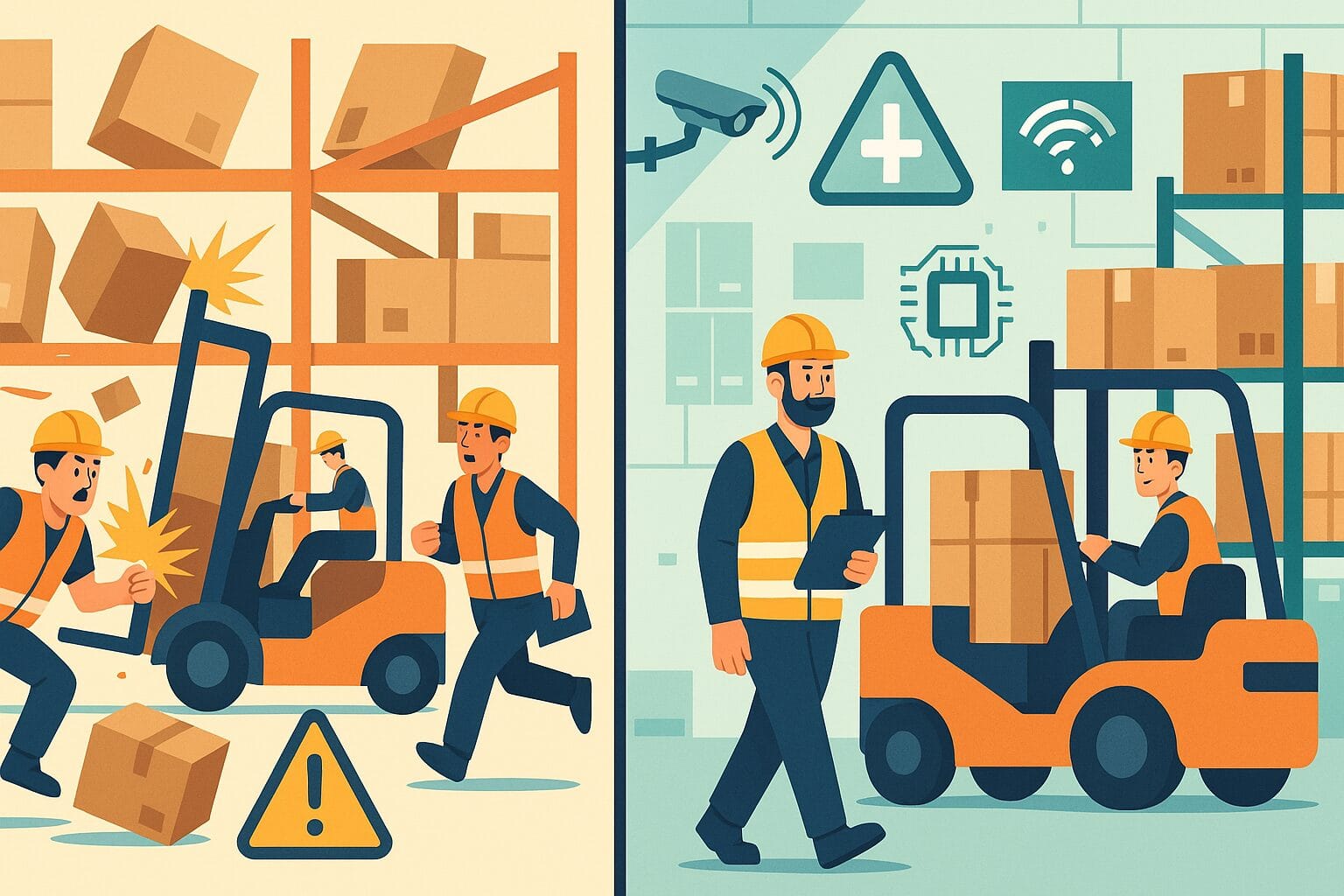
Warehouse Safety Is Broken, and Behaviour Is the Key to Fixing It
Estimated reading time: 8 minutes
Warehouse safety is broken. Despite decades of regulations, checklists, and protective equipment, injury rates in warehousing and storage remain stubbornly high. The U.S. Bureau of Labor Statistics consistently reports that the warehousing sector suffers a total recordable injury rate nearly double the private-industry average. In Vietnam, rapid e-commerce growth has expanded warehouse footprints faster than safety cultures can mature. The missing link is not another poster or a thicker manual — it is behaviour.
Behaviour-based safety (BBS) shifts focus from compliance checkboxes to the daily decisions every associate makes: how they lift, whether they report a near-miss, if they pause before crossing a forklift lane. When leadership embeds behavioural observation, positive reinforcement, and data-driven coaching into operations, incident curves bend downward. This article explores why traditional programmes fall short, what the latest data reveal, and how logistics leaders can rebuild safety from the ground up — starting with behaviour.
Table of Contents
- Why Traditional Warehouse Safety Programmes Fail
- Key Trends and Data Shaping Modern Warehouse Safety
- Operational Impacts on Logistics and Supply Chains
- Practical Lessons for Logistics Professionals
- How Scanwell Logistics Vietnam Can Help
- Conclusion
- FAQ
Why Traditional Warehouse Safety Programmes Fail
Most warehouse safety programmes are built on three pillars: regulation compliance, engineering controls, and personal protective equipment (PPE). These are necessary but insufficient. OSHA standards, Vietnam’s Labour Code, and ISO 45001 set minimum floors — they do not drive excellence. Engineering controls such as guardrails, light curtains, and automated conveyors reduce exposure, yet they cannot eliminate every interaction between people and mobile equipment. PPE protects the worker after an incident occurs; it does not prevent the incident.
The Compliance Trap
Compliance-driven programmes create a culture of “passing the audit.” Associates learn to perform safe behaviours when observed and revert to shortcuts when unobserved. Lagging indicators — recordable rates, lost-time days — are reported monthly, long after the behaviours that caused them have repeated. Leading indicators such as near-miss reporting, observation completion rates, and coaching conversations are rarely tracked with the same rigour.
The Human Factor Gap
Research from the National Safety Council shows that over 80% of workplace injuries involve a behavioural component — distraction, fatigue, rushing, or habitual risk-taking. Traditional programmes treat these as “human error” to be disciplined. Behavioural science reframes them as predictable responses to system design: congested aisles encourage cutting corners; incentive structures that reward volume over safety reinforce speed; supervisor silence on minor deviations normalises risk.
Vietnam Context: Growth Outpaces Culture
Vietnam’s warehousing space has grown at a CAGR above 15% since 2018, driven by manufacturing relocation and cross-border e-commerce. Many new facilities operate with first-time warehouse workforces, limited safety training infrastructure, and supervision ratios that stretch beyond effective coaching. Language diversity in industrial zones adds communication barriers. A behaviour-first approach scales faster than rule-heavy manuals because it relies on peer observation and visual cues that transcend literacy levels.
Key Trends and Data Shaping Modern Warehouse Safety
Data from global logistics operators, industry associations, and technology vendors converge on several trends that make behaviour-based safety both urgent and achievable.
- Automation creates new interaction zones. Autonomous mobile robots (AMRs), goods-to-person systems, and automated storage and retrieval systems (AS/RS) reduce traditional forklift traffic but introduce human-robot interfaces. Associates must learn new behavioural rules: no stepping into robot lanes, proper emergency-stop use, clear handoff protocols at pick stations.
- Real-time location systems (RTLS) enable behavioural analytics. Ultra-wideband and BLE beacons on badges and forklifts capture proximity events, speed violations, and zone dwell times. When paired with AI video analytics, supervisors receive leading-indicator dashboards — not just injury reports.
- Neuroscience informs coaching. Micro-learning modules spaced over weeks (the “spacing effect”) improve retention of safe lifting techniques and hazard recognition far better than annual classroom sessions. Gamified observation apps leverage dopamine loops to sustain engagement.
- Contractor and temp-worker inclusion. In peak season, contingent labour can exceed 40% of headcount. Behavioural programmes that onboard temps in 15 minutes with visual job-aides and assign them a “safety buddy” close the exposure gap.
- Regulatory shift to psychosocial risk. ISO 45003 and Vietnam’s upcoming occupational safety amendments require addressing fatigue, workload, and harassment — all behavioural precursors to physical injury.
Operational Impacts on Logistics and Supply Chains
Warehouse safety is not a siloed HR metric — it cascades through every supply-chain KPI.
Throughput and On-Time Shipping
An injury investigation halts the affected zone for 30–90 minutes. A serious incident can shut down an entire shift. In a high-velocity fulfilment centre processing 50,000 orders per day, one lost shift equals missed cut-offs, carrier penalties, and SLA breaches. Behavioural programmes that reduce recordables by 30–50% directly protect revenue.
Labour Retention and Cost
Warehouse turnover averages 40–60% annually in Southeast Asia. Associates who perceive unsafe conditions leave first. Replacement cost — recruiting, onboarding, lost productivity — ranges from $3,000 to $5,000 per associate. A strong safety culture becomes a recruitment differentiator in tight labour markets like Binh Duong and Long An.
Inventory Integrity
Unsafe behaviours — climbing racks, kicking pallets, overloading beam capacities — cause product damage and location inaccuracies. Behavioural observation catches these deviations before they become shrink or mis-picks.
Customer and Insurance Confidence
Major shippers audit 3PL safety programmes during RFPs. A mature BBS programme with documented leading indicators, coaching logs, and trend analysis scores higher than a binder of OSHA 300 logs. Insurers offer premium credits for demonstrated behavioural risk reduction.
Practical Lessons for Logistics Professionals
- Start every shift with a 3-minute behavioural huddle. Review one specific at-risk behaviour observed yesterday, the safe alternative, and the “why.” No slides — just dialogue.
- Map the “critical few” behaviours per zone. Receiving: trailer restraint use, dock-plate inspection. Picking: three-point contact on ladders, scanner holster use. Packing: box-cutter direction, ergonomic workstation setup. Shipping: load securement, seal verification.
- Deploy digital observation tools, not paper. Mobile apps with photo capture, auto-time-stamp, and offline sync ensure data integrity. Set a target: 1 observation per 20 labour-hours per supervisor.
- Coach in the moment, not in the office. Positive reinforcement (“I saw you use the push-stick — thank you”) outweighs correction 4:1. Correction conversations happen privately, referencing the specific behaviour, not the person.
- Publish leading-indicator dashboards weekly. Observation rate, safe-behaviour percentage, near-miss count, coaching conversations completed. Celebrate teams that improve, not just those with zero injuries.
- Train supervisors in behavioural coaching, not just hazard ID. A 2-day workshop on ABC analysis (Antecedent-Behaviour-Consequence), active listening, and feedback models pays back in months.
- Integrate contractor onboarding into the BBS system. Same observation card, same huddle, same coaching — day one.
- Address fatigue proactively. Schedule rotation for high-repetition tasks, enforce break compliance via badge data, and monitor overtime thresholds.
How Scanwell Logistics Vietnam Can Help
Scanwell Logistics Vietnam operates warehousing and distribution centres across the country’s key logistics corridors — from the northern hubs of Bac Ninh and Hai Phong to the southern engine of Ho Chi Minh City and the Mekong Delta. We understand that safety is not a standalone programme; it is embedded in every process we design for our clients.
Our facilities integrate behaviour-based safety into daily operations through structured observation routines, real-time proximity alerting on material-handling equipment, and a coaching culture led by certified safety professionals. We partner with clients to co-develop critical-behaviour inventories tailored to their product profiles — whether cold-chain pharma, high-velocity e-commerce, or bulky project cargo.
Beyond the warehouse, Scanwell’s end-to-end supply-chain visibility platform extends safety data to transportation and customs clearance stages, giving you a single pane of glass for operational risk. When you entrust your inventory to Scanwell, you gain a partner who treats your people’s safety as the leading indicator of your supply-chain reliability.
- Warehousing & distribution with embedded BBS programmes
- Domestic & cross-border trucking with driver behaviour monitoring
- Ocean freight (FCL/LCL) on major trade lanes
- Air freight for time-critical shipments
- Customs brokerage & trade compliance
- Technology-enabled supply-chain visibility & safety analytics
Conclusion
Warehouse safety is broken because it has been managed as a compliance exercise rather than a behavioural science. The data are clear: facilities that shift to observation-driven, coaching-centric, data-rich behavioural programmes achieve 30–60% reductions in recordable injuries within 18–24 months. They also gain throughput stability, lower turnover, and stronger customer trust.
The transition does not require massive capital. It requires leadership commitment to make safety a daily conversation, supervisors skilled in coaching, and technology that surfaces leading indicators in real time. In Vietnam’s fast-growing logistics landscape, the operators who master this shift will attract the best talent, win the most demanding clients, and build resilient supply chains.
The next time you walk your warehouse floor, ask yourself: “Am I observing behaviour or auditing paperwork?” The answer determines whether your safety programme is a cost centre or a competitive advantage.
Call to Action
Ready to turn these logistics insights into real competitive advantages?
Explore Scanwell Logistics Vietnam
Contact our experts for tailored support
FAQ
What is the first step to launch a behaviour-based safety programme in an existing warehouse?
Start with a behavioural baseline: conduct 200–300 structured observations across all shifts using a standardised checklist of 8–10 critical behaviours. This data defines your starting safe-behaviour percentage and identifies the top three at-risk behaviours to target in the first 90-day sprint.
How do we sustain engagement after the initial launch enthusiasm fades?
Rotate observation responsibilities monthly so fresh eyes see new risks. Publish a one-page “Safety Scorecard” every Monday with leading indicators only. Recognise teams that hit observation targets and improve safe-behaviour percentages — not just zero-injury streaks. Refresh the critical-behaviour list quarterly based on near-miss trends.
Can behaviour-based safety work with a high percentage of temporary or agency workers?
Yes. The key is a 15-minute visual onboarding: a laminated card with pictures of the critical safe/at-risk behaviours, a buddy assignment for the first two shifts, and inclusion in the daily huddle. Temp agencies that co-deliver this onboarding see faster ramp-up and lower early-injury rates.
What technology investments have the fastest ROI for behavioural safety?
Mobile observation apps (low cost, immediate data), RTLS proximity alerts on forklifts (prevents pedestrian strikes), and AI video analytics for ergonomic risk (repetitive lift, awkward posture). Prioritise tools that feed leading-indicator dashboards rather than lagging-incident databases.
How does Scanwell Logistics Vietnam ensure its safety culture extends to client-dedicated warehouses?
We deploy a standardised BBS framework — critical-behaviour mapping, digital observation, weekly coaching cadence — then customise the behaviour list and observation frequency to the client’s operation. Our regional safety managers conduct monthly joint reviews with client stakeholders, sharing leading-indicator trends and co-authoring corrective actions.