Are You Overpaying for Ecommerce Shipping?
Estimated reading time: 8 minutes
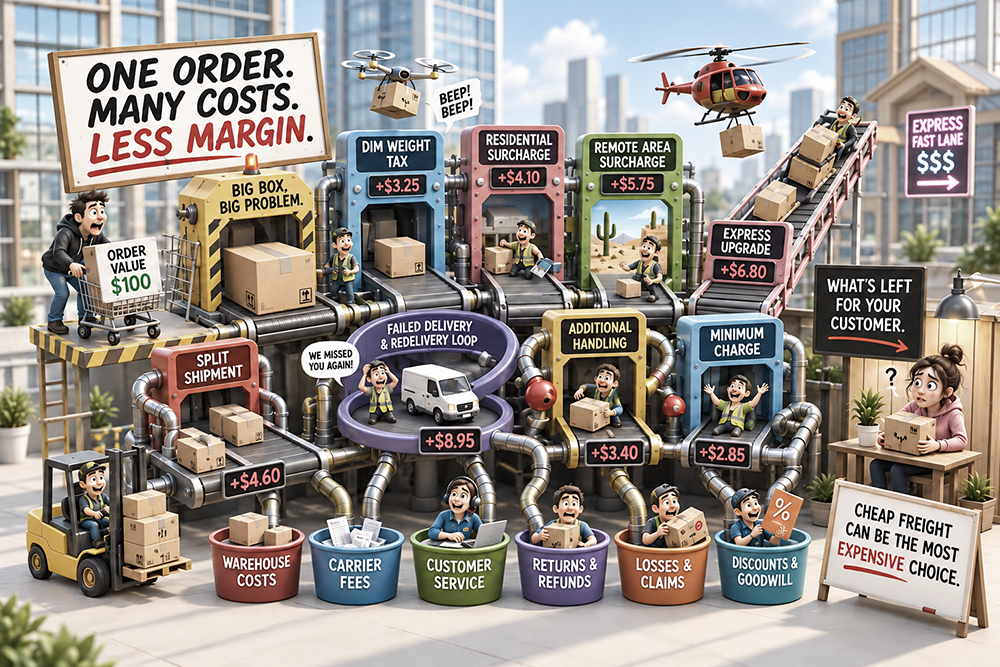
Ecommerce shipping costs have become a silent margin killer for countless online retailers. As consumer expectations for fast, free delivery rise, many businesses absorb escalating carrier rates, surcharges, and accessorial fees without a structured strategy to contain them. The question Are You Overpaying for Ecommerce Shipping? is not just about rate cards—it is about visibility, packaging efficiency, network design, and negotiation leverage.
In today’s competitive landscape, shipping often represents the single largest variable cost after cost of goods sold. Yet, few companies audit their parcel spend with the same rigor applied to procurement or payroll. This article explores the hidden drivers of overspend, the data points every logistics manager should track, and the practical steps to align shipping costs with business growth.
Table of Contents
- Why Ecommerce Shipping Costs Spiral Unnoticed
- Key Cost Drivers: DIM Weight, Zones, and Surcharges
- Operational Impacts on Fulfillment and Customer Experience
- Practical Lessons for Logistics Professionals
- How Scanwell Logistics Vietnam Can Help
- Conclusion
- FAQ
Why Ecommerce Shipping Costs Spiral Unnoticed
Many retailers treat shipping as a fixed utility bill—pay the invoice, move on. This mindset ignores the dynamic nature of carrier pricing models. General Rate Increases (GRIs) occur annually, but accessorial charges—residential delivery, delivery area surcharges, address corrections, and oversized fees—shift quarterly. Without automated invoice auditing, these line items blend into the background.
Another blind spot is contract misalignment. A negotiated agreement optimized for 5 lb parcels shipping to Zone 4 becomes punitive when the product mix shifts to 12 lb items shipping to Zone 8. Volume tier commitments often go unmet due to seasonality, triggering rate resets that catch finance teams off guard. The lack of real-time parcel spend analytics means decisions are made on stale data, locking in overpayment for months.
Key Cost Drivers: DIM Weight, Zones, and Surcharges
Understanding the mechanics of carrier pricing is the first step to controlling it. Three levers dominate the final invoice:
- Dimensional (DIM) Weight Pricing: Carriers charge based on the greater of actual weight or volume-based DIM weight (L x W x H / divisor). Oversized boxes for small items inflate costs exponentially. Right-sizing packaging and using multi-depth boxes can shave 15–30% off parcel spend.
- Shipping Zones & Distance: The U.S. is divided into zones 2–8 based on origin-destination distance. A single warehouse on the coast forces cross-country shipments into expensive zones. Distributed inventory—forward stocking units closer to demand clusters—reduces average zone per order.
- Accessorial Surcharges: Residential surcharges (~$4–$5), Delivery Area Surcharges (DAS), Additional Handling, and Peak Season fees stack quickly. Auditing these charges weekly reveals patterns—e.g., a specific SKU consistently triggering “Additional Handling” due to packaging dimensions.
Technology plays a pivotal role. Multi-carrier shipping software (MCSS) with rate shopping, automated service level selection, and DIM optimization engines turns these variables into controllable inputs rather than surprise expenses.
Operational Impacts on Fulfillment and Customer Experience
Overpaying for shipping does not just hurt the P&L—it distorts operational decisions. When shipping costs are opaque, merchandisers price products without understanding true landed cost per order. Marketing runs “free shipping” promotions that erode contribution margin on low-AOV items. Customer service teams lack visibility into delivery exceptions, leading to reactive refunds instead of proactive carrier interventions.
Inventory placement suffers too. Without zone cost modeling, brands over-stock central warehouses, increasing last-mile expense and transit time. The result: higher cart abandonment, lower repeat purchase rates, and brand erosion. Conversely, a data-driven network—supported by real-time parcel analytics—enables dynamic order routing to the lowest-cost fulfillment node that still meets the delivery promise.
Practical Lessons for Logistics Professionals
- Audit Every Invoice Weekly: Automate parcel audit to catch duplicate charges, late delivery refunds (GSR), and incorrect accessorials. Recover 2–5% of spend annually.
- Right-Size Packaging at the Pack Station: Implement cartonization algorithms that select the smallest viable box per order. Train packers on DIM divisor impact.
- Model Network Scenarios Quarterly: Run “what-if” analyses: add a West Coast FC, shift 20% volume to regional carrier, test hybrid injection. Quantify cost-per-order and transit-time trade-offs.
- Leverage Multi-Carrier Strategy: Don’t rely on a single carrier. Use regional carriers for last-mile density, national carriers for reach, and consolidators for zone skipping. Rate-shop every shipment.
- Negotiate with Data, Not Volume Promises: Bring cleaned shipment-level data (weight, dims, zones, surcharges) to the table. Ask for specific concessions: DIM divisor improvement, DAS waiver, peak surcharge caps.
- Align Shipping Policy with Customer Segments: Offer free shipping thresholds tied to contribution margin, not just AOV. Use real-time rate display at checkout to steer customers to cost-optimal options (e.g., pickup points, slower service).
How Scanwell Logistics Vietnam Can Help
Scanwell Logistics Vietnam combines global freight reach with localized ecommerce fulfillment expertise. We help brands transform shipping from a cost center into a competitive lever through integrated warehousing, distribution, and technology-enabled visibility.
Our team designs distributed inventory strategies across Vietnam and key Southeast Asian hubs, reducing last-mile zones and transit days. We operate multi-client and dedicated fulfillment centers equipped with WMS-driven cartonization, automated carrier selection, and real-time parcel spend dashboards. Customs brokerage and cross-border trucking ensure seamless inbound flow for imported SKUs.
- Ecommerce fulfillment & distribution (B2C / B2B) across Vietnam & SEA.
- Domestic last-mile & cross-border trucking with zone optimization.
- Ocean freight (FCL/LCL) for inbound inventory replenishment.
- Air freight for peak-season velocity and high-value SKUs.
- Customs brokerage, HS classification, and trade compliance.
- Parcel spend analytics, carrier scorecards, and contract benchmarking.
Conclusion
Overpaying for ecommerce shipping is rarely a single mistake—it is the compounding result of opaque invoices, static contracts, and disconnected fulfillment networks. The brands that win treat parcel spend as a managed portfolio: they audit relentlessly, right-size packaging scientifically, model network scenarios continuously, and negotiate from a position of data.
The opportunity is tangible. A 10–20% reduction in cost-per-shipment flows straight to EBITDA without sacrificing delivery speed. More importantly, a optimized shipping operation unlocks better customer experiences, higher conversion, and scalable margins as volume grows.
Call to Action
Ready to turn these logistics insights into real competitive advantages?
Explore Scanwell Logistics Vietnam
Contact our experts for tailored support
FAQ
How do I know if my current carrier contract is competitive?
Benchmark your effective rate (total spend / total shipments) against industry indexes for your weight/zone profile. Request a third-party parcel contract analysis—most consultants perform this at no cost in exchange for a share of identified savings.
What is the fastest way to reduce DIM weight charges?
Implement on-demand box making or a curated carton library (6–8 sizes) paired with cartonization software. Eliminate “air shipping” immediately. For poly-mailer eligible products, switch from boxes to padded mailers to drop below the 1 cubic foot DIM threshold.
When does a distributed fulfillment network make financial sense?
Typically at 3,000+ orders/month with geographically dispersed demand. Run a network optimization model using 12 months of order history (origin, destination, weight, dims). Compare total landed cost (inbound freight + warehousing + last-mile) for 1, 2, and 3 node scenarios.
Can Scanwell Logistics Vietnam manage international returns for my ecommerce store?
Yes. We provide reverse logistics solutions including return consolidation, inspection, repackaging, restocking, or disposal—integrated with your WMS for real-time inventory updates and customer refund triggers.