












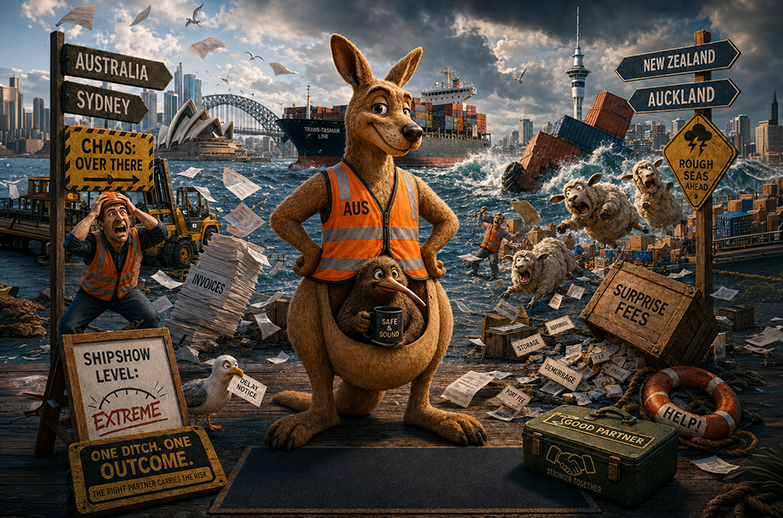
How to Choose a Trans-Tasman Freight Partner: The 12 Questions to Ask Before the Cheap Quote Starts Eating Your Margin
Estimated reading time: 8 minutes
The Trans-Tasman trade lane between New Zealand and Australia is one of the world’s most active short-haul corridors, yet it remains deceptively complex. Distance is short, but regulatory regimes, biosecurity rules, port infrastructure quirks, and seasonal capacity swings create a minefield for shippers who choose a partner based solely on a low headline rate. A cheap quote often masks hidden costs — detention charges, re-work fees, customs delays, and poor visibility — that quietly erode margin quarter after quarter.
This article breaks down the 12 critical questions every supply-chain leader should ask before signing a Trans-Tasman freight agreement. The questions are grouped into five strategic themes: operational expertise, performance reliability, technology and communication, financial and risk controls, and long-term partnership value. By the end you will have a practical evaluation framework you can apply in your next RFP or quarterly business review.
Table of Contents
- Understanding Trans-Tasman Complexity
- Performance Reliability and Risk Management
- Technology, Innovation and Communication
- Financial Controls and Dispute Resolution
- Sustainability and Customer-Centric Service
- Practical Lessons for Logistics Professionals
- How Scanwell Logistics Vietnam Can Help
- Conclusion
- Call to Action
- FAQ
Understanding Trans-Tasman Complexity
The Tasman Sea may look like a simple pond on a map, but the operational reality is a dense web of biosecurity inspections, differing customs valuations, and port-specific slot constraints. Question 1 — “What is your experience with Trans-Tasman freight?” — is the foundation. A partner that has moved thousands of TEUs across this lane knows which Auckland wharf handles project cargo most efficiently, how Sydney’s seasonal berthing windows shift, and when to pre-lodge NZ MPI documentation to avoid 48-hour holds.
Question 3 — “How do you handle customs clearance?” — exposes whether the provider treats clearance as a checkbox or a managed process. Australia’s ABF and New Zealand’s Customs Service have distinct data requirements (e.g., NZ’s CMR vs. Australia’s ICS). A competent partner runs a pre-clearance model: they validate HS codes, origin certificates, and biosecurity declarations before the vessel sails, turning a potential border delay into a non-event.
Question 11 — “How do you handle complex shipments?” — separates generalists from specialists. Reefer pharmaceuticals, oversized machinery, dangerous goods class 4.1, or high-value electronics each demand tailored stowage, monitoring, and contingency plans. Ask for recent case studies: a 40-foot flat-rack moved from Tauranga to Brisbane under a transit-time guarantee, or a multi-temperature consolidation that cleared both borders with zero interventions.
Performance Reliability and Risk Management
On-time delivery is the single most visible KPI, yet many shippers accept vague promises. Question 2 — “What is your track record with on-time deliveries?” — demands data, not anecdotes. Request the last 12 months of port-to-port and door-to-door reliability split by trade direction (NZ→AU vs. AU→NZ), cargo type, and incoterm. A transparent partner will share a dashboard showing median transit time, 90th-percentile tail, and root-cause codes for every late arrival.
Question 7 — “How do you measure your performance?” — reveals the partner’s internal discipline. Look for a balanced scorecard: on-time delivery, transit-time consistency, claims ratio, freight-cost accuracy, and customer-response SLA. Providers that only track “vessel departure” miss the last-mile failures that actually hurt your customers.
Question 9 — “How do you handle unexpected events?” — tests resilience. The Tasman lane faces cyclones, port strikes, and sudden regulatory changes (e.g., Australia’s 2023 brown marmorated stink bug season extensions). A mature 4PL-style partner maintains pre-negotiated space on alternative vessels, bonded warehouse overflow capacity in both countries, and a documented crisis-communication playbook that triggers within 60 minutes of a disruption alert.
Technology, Innovation and Communication
Question 6 — “What is your approach to technology and innovation?” — is often answered with buzzwords. Dig deeper: does the partner offer a single pane of glass for booking, tracking, documents, and exceptions? Can you ingest milestone events via API into your TMS or ERP without manual CSV uploads? Real innovation shows up as predictive ETA models that factor in port congestion, weather, and historical berth productivity — not just AIS pings.
Question 8 — “What is your approach to communication?” — defines the daily working relationship. A strong partner assigns a named account manager backed by a 24/7 operations desk. They proactively push exception alerts (customs hold, roll-over, temperature deviation) rather than waiting for you to ask. Weekly scorecard reviews and quarterly business reviews should be contractual, not optional.
Financial Controls and Dispute Resolution
Question 4 — “What is your approach to freight auditing?” — protects your P&L. Ocean freight invoices frequently contain errors: incorrect bunker adjustment factors, demurrage charged beyond free-time terms, or accessorials never quoted. A rigorous partner runs automated three-way matching (quote vs. booking confirmation vs. carrier invoice) and presents you a clean payable file with variances flagged for approval.
Question 5 — “How do you handle claims and disputes?” — sets expectations for the inevitable. Cargo damage, shortage, or temperature excursion claims on the Tasman lane can stall for months if documentation is weak. Ask for the partner’s average claim settlement time, their liability limit alignment with your cargo value, and whether they manage the carrier claim process end-to-end or simply forward you a form.
Sustainability and Customer-Centric Service
Question 10 — “What is your approach to sustainability?” — is no longer a nice-to-have. Major retailers in both countries now require Scope 3 emissions data per shipment. A forward-thinking partner provides CO₂e grams per TEU-km calculated via GLEC framework, offers lower-carbon routing (e.g., rail-connected ports, slow-steaming options), and participates in recognized programs like Smart Freight Centre or Clean Cargo.
Question 12 — “What is your approach to customer service?” — closes the loop. Beyond responsiveness, evaluate cultural fit: does the partner understand your industry’s peak cycles (wine vintage, kiwifruit harvest, back-to-school retail)? Do they propose continuous-improvement initiatives — lane consolidation, packaging optimization, inventory repositioning — without being prompted? The best partners act as an extension of your supply-chain team, not a transactional vendor.
Practical Lessons for Logistics Professionals
- Map your cargo profiles against the partner’s lane-specific expertise before comparing rates.
- Demand a live KPI dashboard — not a quarterly PDF — for on-time delivery, transit variance, and claims ratio.
- Insist on API-first integration for booking, tracking, and document exchange; eliminate manual email workflows.
- Build automated freight audit into the contract; set a materiality threshold for invoice variances.
- Pre-qualify customs brokers on both sides of the Tasman; verify pre-clearance capability for your top 10 SKUs.
- Test the partner’s contingency plan: simulate a port closure and measure their alternative-routing response time.
- Require per-shipment CO₂e reporting aligned with GLEC; embed it in your ESG disclosures.
- Contract quarterly business reviews with a continuous-improvement agenda, not just a scorecard recap.
How Scanwell Logistics Vietnam Can Help
Although Scanwell Logistics Vietnam is headquartered in Ho Chi Minh City, our global network and 4PL control tower extend across the Asia-Pacific, including the Trans-Tasman corridor. We apply the same 12-question rigour when selecting and managing ocean and air carriers on your behalf, ensuring that the partner handling your New Zealand–Australia freight meets the operational, technological, and financial standards outlined above.
Our services relevant to Trans-Tasman supply chains include:
- Ocean freight (FCL/LCL) on key Asia–Tasman and intra-Tasman trade lanes.
- Air freight solutions for time-sensitive, high-value, or temperature-controlled cargo.
- Warehousing, cross-dock, and value-added services in Vietnam with onward distribution to ANZ.
- Domestic and cross-border trucking coordination through trusted partners.
- Customs brokerage and trade compliance support for Vietnam, Australia, and New Zealand regulations.
- Real-time visibility platform with predictive ETAs, exception alerts, and automated freight audit.
- Carbon-emission reporting per shipment aligned with GLEC framework.
Conclusion
Choosing a Trans-Tasman freight partner is a strategic decision that directly impacts landed cost, customer satisfaction, and supply-chain resilience. The 12 questions in this article move the conversation from “What is your rate?” to “How do you protect my margin across every shipment?” Experience, measurable performance, technology depth, financial rigour, and sustainability commitment are the five pillars that separate a transactional carrier from a true logistics partner.
Leaders who embed this evaluation framework into their procurement cycle will avoid the hidden costs that cheap quotes conceal. They will gain a partner that proactively manages biosecurity risk, resolves disputes before they escalate, and continuously improves the end-to-end flow — turning the Tasman Sea from a cost centre into a competitive advantage.
Call to Action
Ready to turn these logistics insights into real competitive advantages?
Explore Scanwell Logistics Vietnam
Contact our experts for tailored support
FAQ
How many of the 12 questions should I ask during an initial RFP?
All 12. Group them into the five themes above and score each theme separately. A partner that scores poorly on financial controls or technology will create hidden costs even if their operational experience is strong.
What is the typical cost of a freight audit program, and does it pay for itself?
Automated three-way matching typically costs 0.5–1 % of freight spend and recovers 2–4 % in billing errors, delivering a clear ROI within the first quarter.
Can a Vietnam-based 4PL effectively manage a Trans-Tasman lane?
Yes. A 4PL with a global control tower, API-connected carrier network, and local customs-broker partnerships in both New Zealand and Australia can orchestrate the lane end-to-end while providing a single point of accountability.
How do I verify a partner’s sustainability claims?
Request GLEC-aligned CO₂e reports for your last 20 shipments, ask for third-party verification (e.g., Smart Freight Centre), and check whether the partner publishes an annual sustainability report with science-based targets.
What is the first step to switch partners without disrupting my supply chain?
Run a parallel pilot: move 10–15 % of your volume with the new partner for one full quarter while keeping the incumbent on the remainder. Use the 12-question scorecard to compare real-world performance before a full cutover.