














Trans-Tasman Compliance and Documentation: The Customs Playbook for Australia and New Zealand
Estimated reading time: 8 minutes
Navigating Trans-Tasman compliance and documentation is a critical capability for any business moving goods between Australia and New Zealand. While the Australia New Zealand Closer Economic Relations Trade Agreement (ANZCERTA) eliminates tariffs on qualifying goods, the regulatory landscape remains dense with biosecurity controls, rules of origin requirements, and distinct customs clearance systems on each side of the Tasman Sea.
For logistics managers, supply chain directors, and trade compliance officers, mastering this playbook means the difference between seamless same-day clearance and costly border holds, fines, or rejected shipments. This article breaks down the essential documentation, regulatory frameworks, and operational best practices that keep Trans-Tasman freight flowing efficiently.
Table of Contents
- Regulatory Framework: ANZCERTA and Beyond
- Core Documentation Requirements
- Rules of Origin and Preferential Treatment
- Biosecurity and Sanitary Controls
- Digital Clearance Systems and Trusted Trader Programs
- Practical Lessons for Logistics Professionals
- How Scanwell Logistics Vietnam Can Help
- Conclusion
- Call to Action
- FAQ
Regulatory Framework: ANZCERTA and Beyond
The foundation of Trans-Tasman trade is the Australia New Zealand Closer Economic Relations Trade Agreement (ANZCERTA), which entered into force in 1983. It provides for free trade in goods meeting rules of origin, mutual recognition of standards, and cooperation on customs procedures. However, ANZCERTA does not create a single customs territory; each country maintains sovereign border controls, biosecurity regimes, and tax systems.
Key regulatory bodies include the Australian Border Force (ABF) and the New Zealand Customs Service (NZCS). Both agencies operate under modern customs legislation—the Customs Act 1901 (Australia) and the Customs and Excise Act 2018 (New Zealand)—which mandate electronic lodgement, risk-based intervention, and trader accountability. Additionally, biosecurity authorities (Department of Agriculture, Fisheries and Forestry in Australia; Ministry for Primary Industries in New Zealand) enforce strict import health standards independent of customs.
Businesses must also comply with Goods and Services Tax (GST) obligations: 10% in Australia (with deferred GST schemes for importers) and 15% in New Zealand. The Low Value Goods regimes in both countries now capture offshore sellers, adding another compliance layer for e-commerce fulfilment across the Tasman.
Core Documentation Requirements
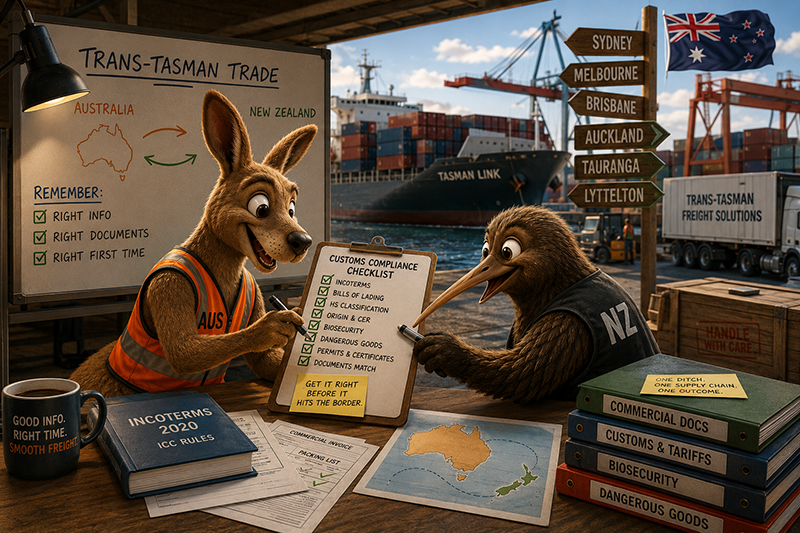
Accurate, complete documentation is the single biggest factor in achieving automatic clearance. The minimum document set for every Trans-Tasman shipment includes:
- Commercial Invoice – Must show seller, buyer, full description, quantity, unit price, total value, currency, Incoterms, and country of origin for each line item.
- Packing List – Gross/net weight, dimensions, marks and numbers, package count per line item.
- Transport Document – Bill of Lading (sea) or Air Waybill (air) with correct consignee/notify party details.
- Certificate of Origin (COO) – Required to claim ANZCERTA preferential rates. Must be issued by an authorised body (e.g., Chamber of Commerce) or via self-certification under the Approved Exporter Scheme.
- Phytosanitary / Animal Health Certificates – Mandatory for plant products, animal products, food, and regulated risk goods. Must be issued by the exporting country’s competent authority.
- Import Permits / Approvals – Required for restricted goods (e.g., certain chemicals, pharmaceuticals, weapons, heritage items).
Both ABF and NZCS require electronic lodgement via their Integrated Cargo Systems (ICS in Australia, Joint Border Management System in NZ). House-level data (bill of lading/air waybill level) must be submitted pre-arrival. Incomplete or inaccurate data triggers documentary holds (DOC) or physical examinations (EXM), adding 24–72 hours and inspection fees.
Rules of Origin and Preferential Treatment
To qualify for zero tariffs under ANZCERTA, goods must satisfy the Rules of Origin (ROO). The general rule: goods must be wholly obtained or produced in the exporting country, or undergo a substantial transformation there. Specific Product-Specific Rules (PSRs) apply to textiles, clothing, automotive, and certain processed foods—often requiring a change in tariff classification (CTC) or a regional value content (RVC) threshold (typically 50% FOB).
Documentation of origin is critical. Options include:
- Official Certificate of Origin – Issued by authorised chambers of commerce.
- Approved Exporter Self-Certification – Exporters authorised by customs can declare origin on the commercial invoice using a prescribed statement and authorisation number.
- Declaration of Origin by Producer – Accepted in some cases where the exporter is not the producer.
Importers must hold valid origin evidence at the time of import declaration. Post-import verification audits are common; failure to produce records can result in duty demands, penalties, and loss of preferential status for future shipments.
Biosecurity and Sanitary Controls
Biosecurity is the most frequent cause of Trans-Tasman border delays. Both countries maintain stringent measures to protect agriculture and environment. Key requirements:
- Plant Products – Require phytosanitary certificates verifying freedom from pests/diseases. Many fresh fruits, vegetables, cut flowers, and timber need import permits and pre-shipment treatment (fumigation, cold treatment, heat treatment).
- Animal Products – Meat, dairy, seafood, hides, and by-products require veterinary health certificates. Some products are prohibited or restricted to approved establishments.
- Packaging Materials – Wood packaging (pallets, crates, dunnage) must comply with ISPM-15 (heat-treated or methyl bromide fumigated, marked with IPPC logo). Non-compliant packaging is directed for treatment or re-export at importer expense.
- Container Cleanliness – Containers must be free of soil, plant debris, seeds, and animal contaminants. Joint inspections by customs and biosecurity officers target high-risk pathways.
Pre-clearance strategies—such as offshore treatment certification, approved arrangement sites (Australia) or transitional facilities (NZ), and the use of biosecurity-precleared cargo programs—can significantly reduce border dwell time.
Digital Clearance Systems and Trusted Trader Programs
Both Australia and New Zealand have invested heavily in digital border ecosystems. Understanding these systems is essential for compliance efficiency:
- Australia – Integrated Cargo System (ICS) – Supports pre-arrival reporting (sea: 48h; air: 2h), electronic import declarations (N10), and automated tariff classification advice. The Australian Trusted Trader (ATT) program offers benefits like reduced inspections, priority clearance, and a dedicated account manager for accredited businesses.
- New Zealand – Joint Border Management System (JBMS) – Replaces the old CusMod system. Supports electronic lodgement of import entries (NZCS 224), risk profiling, and integration with MPI biosecurity declarations. The Secure Exports Scheme (SES) and Customs Valued Trader programmes provide similar trusted-trader benefits.
- Mutual Recognition Arrangements (MRAs) – AEO/Trusted Trader mutual recognition between Australia, New Zealand, and other partners (e.g., Canada, USA, EU, Singapore) enables reciprocal benefits for accredited operators.
Investment in customs brokerage software or ERP integration that connects directly to ICS/JBMS via API reduces manual entry errors and accelerates clearance. Real-time cargo tracking linked to customs status events (e.g., “Arrived”, “Assessed”, “Cleared”, “Held”) gives supply chain visibility for proactive exception management.
Practical Lessons for Logistics Professionals
- Validate origin before shipment – Confirm Rules of Origin compliance and secure COO/Approved Exporter authorisation before cargo departs. Last-minute origin disputes cause demurrage and storage charges.
- Pre-lodge declarations – Submit import entries and biosecurity declarations pre-arrival using all available data (commercial invoice, packing list, transport doc). Amend post-arrival if needed; early lodgement secures an earlier clearance queue position.
- Classify tariff codes centrally – Maintain a master HS code database with legal notes, GST treatment, and biosecurity flags per SKU. Assign classification responsibility to a trained trade compliance specialist, not warehouse staff.
- Map biosecurity pathways per commodity – For each product line, document: import permit needed? treatment required? approved arrangement/transitional facility mandatory? End-to-end cold chain or fumigation certificates?
- Automate document flow – Use EDI/API to push commercial invoices, packing lists, and certificates from suppliers/exporters directly into your customs broker’s system. Eliminate email attachments and manual re-keying.
- Leverage Trusted Trader status – If volume justifies, pursue ATT (Australia) or SES/Valued Trader (NZ). The ROI comes from lower inspection rates, deferred duty/GST accounts, and priority support during peak periods or disruptions.
- Establish a border exception protocol – Define escalation contacts, decision authorities, and cost thresholds for holds, exams, treatments, or re-exports. Pre-negotiate treatment provider rates and storage terms at key ports (Sydney, Melbourne, Brisbane, Auckland, Christchurch).
How Scanwell Logistics Vietnam Can Help
Scanwell Logistics Vietnam brings deep expertise in Trans-Tasman trade lanes, combining regional knowledge with global network reach. We support importers and exporters with end-to-end compliance management, from origin documentation to final-mile delivery in Australia and New Zealand.
Our licensed customs brokerage partners in Sydney, Melbourne, Brisbane, Auckland, and Christchurch operate directly in ICS and JBMS, ensuring accurate, timely lodgements. We manage biosecurity pre-clearance, approved arrangement site coordination, and trusted trader programme applications on your behalf.
Beyond clearance, Scanwell provides integrated ocean freight (FCL/LCL), air freight, warehousing, and distribution solutions—enabling you to consolidate compliance, transport, and inventory management under a single accountable partner.
- Ocean freight (FCL/LCL) on key Trans-Tasman and Asia–ANZ lanes.
- Air freight solutions for time-sensitive and high-value cargo.
- Warehousing, cross-docking, and value-added services in Vietnam and ANZ.
- Domestic trucking and cross-border transport coordination.
- Customs brokerage, tariff classification, and trade compliance advisory.
- Digital visibility platform with customs status tracking and exception alerts.
Conclusion
Trans-Tasman trade offers unparalleled market access under ANZCERTA, but the compliance burden is real and evolving. Success hinges on three pillars: document precision (origin, value, description), biosecurity readiness (permits, treatments, clean packaging), and digital fluency (pre-lodgement, trusted trader programmes, system integration).
Logistics leaders who embed compliance into their supply chain design—rather than treating it as a last-mile checkpoint—gain predictable clearance, lower landed costs, and resilient customer service. The regulatory divergence between Australia and New Zealand (GST regimes, biosecurity lists, digital platforms) demands specialised local knowledge backed by integrated technology.
As both countries advance their digital border strategies and expand mutual recognition networks, the competitive advantage will shift to traders who invest early in automation, accreditation, and expert partnerships.
Call to Action
Ready to turn these logistics insights into real competitive advantages?
Explore Scanwell Logistics Vietnam
Contact our experts for tailored support
FAQ
Do all goods traded between Australia and New Zealand qualify for zero tariffs under ANZCERTA?
No. Only goods that meet the Rules of Origin (wholly obtained or sufficiently transformed in the exporting country) qualify. Product-Specific Rules apply to sectors like textiles, clothing, automotive, and certain foods. A valid Certificate of Origin or Approved Exporter declaration is required to claim preference.
What is the most common cause of customs delays on the Trans-Tasman route?
Biosecurity interventions—missing or incorrect phytosanitary/veterinary certificates, non-ISPM-15 compliant wood packaging, and container contamination—are the top cause of holds and examinations. Pre-clearance preparation and approved arrangement sites mitigate this risk.
Can I use a single customs broker for both Australia and New Zealand clearances?
Most international freight forwarders (including Scanwell) coordinate through licensed broker partners in each country. While a single point of contact manages the file, legal lodgement must be made by a broker licensed in the respective jurisdiction (ABF-licensed in Australia, NZCS-licensed in New Zealand).
How does the Low Value Goods regime affect B2C shipments across the Tasman?
Both countries now require offshore sellers (or their marketplace/platform) to register, collect, and remit GST on consignments valued at or below AUD 1,000 / NZD 1,000. This applies to e-commerce fulfilment from Vietnam or other origins directly to consumers in ANZ. Compliance requires GST registration in each country and periodic returns.
What are the benefits of becoming an Australian Trusted Trader or NZ Secure Exports Scheme member?
Benefits include reduced documentary and physical inspection rates, priority clearance lanes, deferred duty/GST payment arrangements, dedicated customs account managers, and mutual recognition with partner economies (e.g., USA C-TPAT, EU AEO, Canada, Singapore). The accreditation process takes 6–12 months and requires demonstrated compliance history and supply chain security standards.