


















CommandView™ and AdvancedDock™ Add On-Device Intelligence for Secure, Real-Time Enterprise AI
Estimated reading time: 8 minutes
The logistics industry stands at a crossroads where speed, security, and intelligence must converge at the edge of operations. CommandView™ and AdvancedDock™ Add On-Device Intelligence for Secure, Real-Time Enterprise AI represents a pivotal shift in how enterprises can deploy artificial intelligence directly onto devices — warehouses, trucks, handheld scanners, and dock doors — without relying solely on cloud connectivity. This development matters because modern supply chains generate massive data streams at the point of activity, yet traditional cloud-centric AI architectures introduce latency, bandwidth costs, and cyber exposure that can undermine real-time decision-making.
As global trade volumes grow and customer expectations tighten, logistics leaders need AI that works where the work happens: on the forklift, at the loading dock, inside the container yard. The research highlights that conventional enterprise AI solutions often suffer from sluggish response times and vulnerability to cyber threats, especially when data must traverse public networks to centralized servers. CommandView and AdvancedDock address these gaps by embedding intelligence on the device itself, enabling immediate insights — anomaly detection, predictive maintenance, route optimization, security monitoring — without round-trip dependency. In the sections that follow, we explore the context, trends, operational impacts, and practical steps logistics organizations can take to harness on-device AI securely and effectively.
Table of Contents
- Understanding On-Device Intelligence in the Logistics Context
- Key Trends Driving Edge AI Adoption in Supply Chains
- Operational Impacts on Logistics and Supply Chain Execution
- Practical Lessons for Logistics Professionals
- How Scanwell Logistics Vietnam Can Help
- Conclusion
- FAQ
Understanding On-Device Intelligence in the Logistics Context
On-device intelligence — often called edge AI — refers to the deployment of machine learning models and inference engines directly on hardware at the network periphery: rugged tablets, fixed industrial PCs, smart cameras, gateway controllers, and even embedded modules inside material-handling equipment. Unlike cloud-only models, where sensor data streams to a remote data center for processing and results return seconds or minutes later, on-device inference executes locally, often in milliseconds. For logistics, this distinction is operational, not academic.
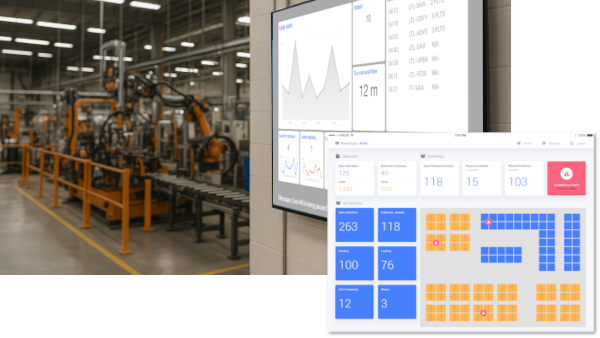
The research notes that CommandView and AdvancedDock bring this capability to enterprise environments with an emphasis on security and real-time responsiveness. CommandView provides a unified management and monitoring layer for fleets of intelligent devices, while AdvancedDock extends the intelligence to docking and loading operations — critical choke points where throughput, safety, and compliance intersect. Together, they form a stack that lets logistics operators run AI workloads — computer vision for pallet identification, anomaly detection for equipment health, natural language interfaces for voice-directed picking — without surrendering data sovereignty or suffering cloud latency.
Why does this matter now? Three forces converge: (1) the proliferation of IoT sensors across warehouses, yards, and fleets has created data volumes that strain upstream bandwidth; (2) regulatory and customer demands for data residency and security push processing toward the edge; (3) use cases like autonomous yard trucks, real-time dock scheduling, and instant customs documentation validation require sub-second latency that cloud round-trips cannot guarantee. On-device intelligence answers all three.
Key Trends Driving Edge AI Adoption in Supply Chains
The logistics sector is undergoing a quiet but profound transformation in how intelligence is distributed across the network. The research underscores the growing pressure on enterprises to improve both efficiency and security simultaneously — a dual mandate that edge AI uniquely satisfies. Below are the primary trends shaping adoption.
- Warehouse automation demands local inference. Automated storage and retrieval systems (AS/RS), autonomous mobile robots (AMRs), and conveyor sortation all generate high-frequency telemetry. Sending every vibration reading, vision frame, or pick confirmation to the cloud is cost-prohibitive and fragile. On-device models filter, classify, and act locally — only exceptions and summaries travel upstream.
- Fleet and yard telematics move to the edge. Modern tractors, trailers, and yard spotters brim with cameras, lidar, and CAN-bus data. Real-time driver safety alerts, trailer detection at dock doors, and predictive brake wear analysis require inference at the vehicle. CommandView’s fleet-wide orchestration ensures model consistency and over-the-air updates across hundreds of assets.
- Zero-trust security architectures favor local processing. The research highlights vulnerability of traditional cloud-dependent AI to cyber threats. By keeping sensitive operational data — facility layouts, shipment manifests, customer PII — on-premises or on-device, the attack surface shrinks. AdvancedDock’s secure boot, hardware-rooted attestation, and encrypted model storage exemplify this principle.
- Silicon advances make edge AI economically viable. New generations of systems-on-module (SoMs) and AI accelerators (NPUs, TPUs) deliver 10–50 TOPS at single-digit wattage, fitting inside rugged enclosures. Model quantization (INT8, INT4) and compilation toolchains (TensorRT, ONNX Runtime, OpenVINO) let standard models run on industrial hardware without data-center GPUs.
- Hybrid cloud-edge orchestration becomes standard. Enterprises no longer choose cloud or edge; they orchestrate both. Training and model registry live in the cloud; inference and data preprocessing live at the edge. CommandView embodies this hybrid paradigm — centralized policy, decentralized execution.
Operational Impacts on Logistics and Supply Chain Execution
Adopting on-device intelligence reshapes daily operations across freight forwarding, warehousing, transportation, and customs compliance. The research emphasizes that CommandView and AdvancedDock target secure, real-time enterprise AI — qualities that translate into tangible workflow improvements.
Warehouse & Distribution Center
At the dock door, AdvancedDock’s computer vision models can verify seal integrity, read container numbers, and match bills of lading in real time — eliminating manual clipboard checks and reducing gate-in time from minutes to seconds. Inside the facility, on-device models on pick carts and forklifts detect mis-picks, guide put-away via augmented reality overlays, and monitor congestion to dynamically re-route traffic. Because inference is local, Wi-Fi dead zones or WAN outages never halt decision-making.
Port & Terminal Operations
Container terminals operate on tight slot schedules. Edge AI on quay cranes and straddle carriers can predict spreader twist-lock failures, optimize twin-lift sequences, and detect chassis damage before it blocks a lane. CommandView’s centralized dashboard gives terminal operating systems (TOS) a live view of device health, model versions, and inference confidence scores — enabling proactive maintenance instead of reactive firefighting.
Air Cargo & Express Networks
Time-definite air freight demands sub-minute turnarounds at sort hubs. On-device intelligence on conveyor diverters and X-ray scanners classifies shipments, flags hazardous material anomalies, and reroutes non-conforming pieces without waiting for a central server. The research’s emphasis on real-time processing aligns directly with the 90-second sort window many express carriers target.
Customs, Compliance & Documentation
Trade compliance increasingly requires real-time data sharing with authorities (e.g., Vietnam’s VNACCS/VCIS, ASEAN Single Window). On-device AI can pre-validate HS codes, extract certificate-of-origin fields from scanned PDFs, and reconcile manifest discrepancies before submission — reducing hold times and penalties. Local processing ensures commercial sensitivity of trade data never leaves the facility perimeter.
Workforce Enablement & Safety
Voice-directed picking, AR-guided loading, and wearable fatigue monitors all benefit from on-device inference. Workers receive instant feedback — “wrong aisle,” “overweight pallet,” “rest break due” — without network latency. CommandView’s fleet management extends to wearable fleets, ensuring firmware, models, and security certificates stay current across shifts and sites.
Practical Lessons for Logistics Professionals
Moving from concept to production with on-device AI requires disciplined engineering and organizational readiness. The following lessons distill patterns observed in early enterprise deployments.
- Start with a bounded, high-value use case. Don’t boil the ocean. Pilot on a single dock door, one yard zone, or a defined fleet segment. Measure cycle-time reduction, error-rate drop, or labor-hour savings. Expand only after ROI is documented.
- Design for intermittent connectivity. Assume devices will lose WAN access. Cache inference results locally; sync when connectivity returns. Use conflict-free replicated data types (CRDTs) or event-sourcing for eventual consistency.
- Invest in model lifecycle ops (MLOps) from day one. Version models, data schemas, and inference configs together. Automate A/B testing on device cohorts. CommandView’s orchestration layer should manage rollout, rollback, and canary deployments across thousands of endpoints.
- Harden the device supply chain. Secure boot, TPM 2.0, signed firmware, and hardware-rooted device identity are non-negotiable. AdvancedDock’s attested boot chain is a reference architecture — replicate its principles across all edge hardware.
- Co-design with frontline workers. Operators know the edge cases: glare on barcode labels, radio interference near refrigeration units, gloves that defeat touchscreens. Involve them in data labeling, UI testing, and failure-mode analysis.
- Model total cost of ownership (TCO), not just hardware. Include model retraining frequency, OTA bandwidth, device lifecycle (3–5 years for rugged kit), and security patch cadence. Cloud egress savings often fund the edge hardware within 12–18 months.
- Align with IT/OT convergence governance. Edge AI blurs the line between operational technology (PLCs, SCADA) and information technology. Establish a joint steering committee: CISO, CIO, VP Operations, and plant managers. Define data classification, incident response, and change-control policies for edge workloads.
How Scanwell Logistics Vietnam Can Help
Scanwell Logistics Vietnam operates at the intersection of physical supply-chain execution and digital enablement. As a full-service logistics provider — ocean freight, air freight, warehousing, distribution, customs brokerage, and domestic trucking — we understand that technology must serve operational reality, not the reverse. The emergence of on-device intelligence platforms like CommandView and AdvancedDock aligns with our commitment to giving customers visibility, control, and resilience at every node of their network.
We help clients evaluate where edge AI delivers measurable value: reducing dock-to-stock time, cutting yard congestion, improving first-pass customs clearance, or protecting cold-chain integrity. Our team collaborates with your IT and operations stakeholders to design pilot scopes, select ruggedized hardware, integrate with existing WMS/TMS/ERP, and establish the security and MLOps guardrails that enterprise deployments demand. The result is not a science project — it’s a production capability that survives peak season, network outages, and audit scrutiny.
- Ocean freight (FCL/LCL on key trade lanes) with real-time container tracking and predictive ETA.
- Air freight solutions for time-sensitive cargo, including priority handling and charter options.
- Warehousing, distribution, and value-added services (kitting, labeling, quality inspection) across Vietnam.
- Domestic and cross-border trucking with GPS-enabled fleet visibility.
- Customs brokerage and trade compliance support for Vietnam and ASEAN regimes.
- Technology-enabled visibility platform integrating edge IoT, AI insights, and cloud analytics.
Conclusion
The research makes a clear case: CommandView™ and AdvancedDock™ Add On-Device Intelligence for Secure, Real-Time Enterprise AI is more than a product announcement — it signals a structural shift in how logistics intelligence is architected. By moving inference to the edge, enterprises gain speed, resilience, and security that cloud-only models cannot deliver. The operational impacts span every logistics domain: faster gate turns, safer yards, smarter warehouses, compliant documentation, and empowered workforces.
Yet technology alone does not create advantage. Success depends on disciplined use-case selection, rigorous MLoT (Machine Learning Operations) practices, zero-trust device hardening, and deep collaboration between IT, OT, and frontline teams. The organizations that treat on-device AI as a capability — not a project — will compound returns across peak seasons, disruptions, and evolving trade regulations.
For logistics leaders in Vietnam and across ASEAN, the window to build this capability is now. The hardware is ready, the models are mature, and the orchestration platforms (like CommandView) exist to manage fleets of intelligent devices at scale. The remaining variable is execution.
Call to Action
Ready to turn these logistics insights into real competitive advantages?
Explore Scanwell Logistics Vietnam
Contact our experts for tailored support
FAQ
What is on-device intelligence, and how does it differ from cloud AI?
On-device intelligence runs machine learning inference directly on hardware at the network edge — rugged tablets, gateways, cameras, vehicles — without requiring a continuous cloud connection. Cloud AI sends data to remote servers for processing. On-device AI delivers sub-second latency, works offline, keeps sensitive data local, and reduces bandwidth costs.
How do CommandView and AdvancedDock improve security for logistics operations?
CommandView provides centralized, policy-driven management of edge devices — secure boot, hardware-rooted attestation, encrypted model storage, and over-the-air updates with rollback protection. AdvancedDock extends this to dock-door workloads, ensuring that video streams, manifest data, and compliance checks never leave the facility perimeter unencrypted. Together they shrink the attack surface inherent in cloud-dependent architectures.
What logistics use cases benefit most from on-device AI today?
High-impact starters include: real-time container/shipment verification at gate-in, automated pallet identification and damage detection, predictive equipment maintenance on material-handling assets, driver safety and fatigue monitoring in-cab, and customs document pre-validation before electronic submission. Each delivers measurable cycle-time or error-rate improvements within a contained pilot scope.
Does deploying on-device AI require replacing existing WMS/TMS/ERP systems?
No. CommandView and similar platforms integrate via standard APIs (REST, MQTT, OPC UA) and edge connectors. Inference results — exception alerts, confirmed counts, anomaly scores — feed into existing systems as enriched events. The goal is augmentation, not rip-and-replace.
How can Scanwell Logistics Vietnam support our edge AI journey?
We bring domain expertise across ocean, air, warehousing, trucking, and customs in Vietnam and ASEAN. Our team helps you scope pilots, select rugged hardware, integrate with your current stack, establish MLoT and security governance, and scale from proof-of-value to multi-site production. Contact us to map the first use case to your operational KPIs.