








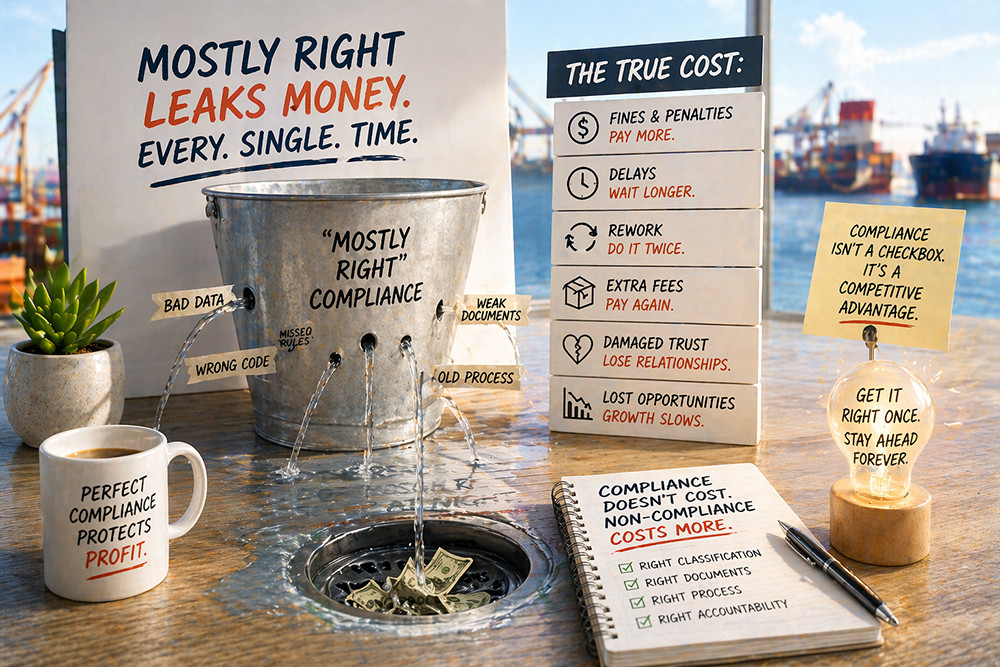
The True Cost of Getting Compliance ‘Mostly Right’
Estimated reading time: 9 minutes
In the high-stakes world of international trade, there is a dangerous phrase often whispered in boardrooms and logistics departments: “It’s mostly right.” Whether it is a slightly misclassified HS code, a missing signature on a Certificate of Origin, or a minor discrepancy in cargo weight, many businesses operate under the illusion that “mostly right” is good enough to keep the supply chain moving. However, in the eyes of customs authorities and international regulators, compliance is binary. You are either compliant, or you are not.
As Vietnam continues to solidify its position as a global manufacturing powerhouse, the complexity of The True Cost of Getting Compliance ‘Mostly Right’ has never been more apparent. With the proliferation of Free Trade Agreements (FTAs) like the EVFTA and CPTPP, the technical requirements for moving goods across borders have intensified. What might seem like a negligible clerical error today can snowball into a catastrophic financial and operational nightmare tomorrow. For supply chain managers and business leaders, understanding these hidden costs is the first step toward building a truly resilient logistics strategy.
This article explores the multi-faceted impact of compliance failures—ranging from immediate financial penalties to long-term reputational damage. We will analyze why the “mostly right” approach fails in the modern logistics landscape and how companies can transition toward a culture of total compliance to safeguard their bottom line and ensure seamless global operations.
Table of Contents
- The Anatomy of the “Mostly Right” Fallacy
- The True Cost of Getting Compliance ‘Mostly Right’: Direct Financial Impacts
- Operational Bottlenecks and Secondary Supply Chain Disruptions
- The Intangible Drain: Reputation and Trust
- Practical Lessons for Logistics Professionals
- How Scanwell Logistics Vietnam Can Help
- Conclusion
- FAQ
The Anatomy of the “Mostly Right” Fallacy
Compliance in logistics is often viewed as a “check-the-box” exercise—a necessary hurdle to clear before the real work of transportation begins. The “mostly right” fallacy occurs when a company prioritizes speed over accuracy. This mindset assumes that customs officials are either too busy to notice minor errors or that the consequences of a mistake are easily reversible. In reality, the modern regulatory environment is increasingly data-driven and automated.
Customs agencies worldwide, including the General Department of Vietnam Customs, are utilizing sophisticated risk-management systems. These systems flag inconsistencies in documentation automatically. When a company submits “mostly right” data, they are essentially flagging themselves for manual inspection. This transition from “Green Channel” (fast-track) to “Red Channel” (full inspection) status is where the costs begin to mount.
Furthermore, compliance isn’t just about the paperwork that accompanies a shipment; it’s about the entire lifecycle of the product. This includes labor standards, environmental regulations, and the origin of raw materials. Getting these “mostly right” is no longer an option in an era of strict ESG (Environmental, Social, and Governance) reporting and anti-forced labor laws, such as the UFLPA in the United States.
The True Cost of Getting Compliance ‘Mostly Right’: Direct Financial Impacts
When discussing The True Cost of Getting Compliance ‘Mostly Right’, the most visible impact is the financial penalty. However, the direct fine is often just the tip of the iceberg.
Regulatory Fines and Penalties
Customs authorities have the power to levy heavy fines for misclassification of goods. If a product is imported under a lower-duty HS code by “mistake,” the importer is not only liable for the back-dated duties but also interest and punitive fines that can exceed the value of the goods themselves. In some jurisdictions, repeated “mostly right” errors can lead to the revocation of import/export licenses.
Storage and Demurrage Charges
A compliance error usually results in the cargo being held at the port or terminal. While the paperwork is being corrected, the clock is ticking on:
- Demurrage: Fees charged by the shipping line for the use of the container inside the terminal beyond the free-time period.
- Detention: Fees for holding the container outside the terminal for too long.
- Storage: Port authority fees for the physical space occupied by the cargo.
These daily charges can easily reach hundreds or thousands of dollars per container, quickly erasing any profit margin the shipment was intended to generate.
Operational Bottlenecks and Secondary Supply Chain Disruptions
The ripple effect of a compliance delay is felt throughout the entire supply chain. When a shipment is held because the documentation was “mostly right,” it creates a localized bottleneck that can paralyze downstream operations.
For manufacturers in Vietnam operating on a Just-In-Time (JIT) basis, a 48-hour customs hold due to a compliance discrepancy can lead to a total production line shutdown. The cost of an idle factory far outweighs the cost of the original shipment. Employees must be paid, contracts with customers might be breached, and emergency “rush” shipments—often via expensive air freight—must be organized to fill the gap.
Moreover, compliance errors impact inventory management. When goods are stuck in “customs limbo,” they are technically in the system but unavailable for sale. This leads to stockouts, missed seasonal windows, and the need to carry higher safety stock levels to buffer against “compliance-induced” volatility. Carrying extra inventory ties up working capital that could otherwise be used for business growth.
The Intangible Drain: Reputation and Trust
Beyond the balance sheet, The True Cost of Getting Compliance ‘Mostly Right’ manifests in the erosion of trust. In the logistics ecosystem, your “compliance score” is a currency.
Customs authorities maintain internal risk profiles for every importer and exporter. If you are known for “mostly right” documentation, you will be flagged for more frequent audits and physical inspections. This creates a vicious cycle of delays that your competitors, who prioritize “exactly right” compliance, do not face.
Furthermore, your relationships with partners are at risk. Shipping lines and freight forwarders prefer clients who have their paperwork in order. A “problematic” shipper might find it harder to secure space during peak seasons or may be subjected to higher service fees to cover the administrative burden of fixing their errors. Most importantly, your end customers lose faith in your ability to deliver reliably. In a global market, reliability is often the primary differentiator.
Practical Lessons for Logistics Professionals
Transitioning from “mostly right” to “consistently compliant” requires a strategic shift in how a company views its logistics and administrative functions. Here are the best practices for logistics managers:
- Invest in Professional HS Classification: Don’t guess. Use expert customs brokers or specialized software to ensure every item is classified correctly according to the latest Harmonized System updates.
- Automate Documentation: Manual data entry is the leading cause of “mostly right” errors. Implementing a Digital Supply Chain platform can help sync data from Purchase Orders directly to Customs Declarations.
- Conduct Internal Audits: Don’t wait for customs to find an error. Regularly audit your past 12 months of shipments to identify patterns of inaccuracy and rectify them proactively.
- Partner with Experts: Regional regulations in Vietnam and Southeast Asia change rapidly. A local partner with deep regulatory knowledge is essential for navigating complex trade lanes.
How Scanwell Logistics Vietnam Can Help
At Scanwell Logistics Vietnam, we believe that compliance is the backbone of a successful global supply chain. We understand that for our clients, a shipment isn’t just a box; it’s a promise to their customers. That is why we go beyond mere transportation to provide comprehensive compliance and advisory services.
Our team of experts stays ahead of the latest regulatory changes in Vietnam and across the globe, ensuring that your cargo moves smoothly and without the hidden costs of “mostly right” mistakes. We provide the visibility and precision needed to turn compliance from a risk into a competitive advantage.
- Customs Brokerage: Expert handling of declarations, HS code verification, and duty optimization.
- Ocean & Air Freight: Reliable transportation with fully integrated documentation support.
- Warehousing & Distribution: Secure storage with accurate inventory tracking and reporting.
- Trade Consultancy: Helping you navigate FTAs like EVFTA, CPTPP, and RCEP to maximize benefits legally.
- Digital Visibility: Real-time tracking and document management to keep all stakeholders informed.
Conclusion
In conclusion, The True Cost of Getting Compliance ‘Mostly Right’ is far higher than most businesses realize. It is measured in liquidated damages, soaring demurrage fees, production downtime, and a tarnished reputation. In the modern logistics landscape, precision is not a luxury—it is a survival requirement.
By moving away from the “mostly right” mentality and investing in robust compliance processes, technology, and expert partnerships, businesses can protect their bottom line and build a supply chain that is truly resilient against global shocks. Remember: in the world of customs, the only way to get it right is to get it 100% right.
Call to Action
Ready to eliminate the hidden costs of compliance errors and streamline your supply chain?
Explore Scanwell Logistics Vietnam’s Compliance Solutions
Contact our experts today for a compliance health check
FAQ
What is the most common compliance error in logistics?
Misclassification of goods using incorrect HS (Harmonized System) codes is the most frequent error. This leads to incorrect duty payments and can trigger audits and heavy fines.
How does a compliance delay affect my shipping costs?
Beyond potential fines, delays lead to demurrage and detention charges, which are daily fees for container use. Additionally, you may face “expedited shipping” costs for replacement goods if the original shipment is held indefinitely.
Can a freight forwarder like Scanwell help with customs audits?
Yes. An experienced partner like Scanwell Logistics Vietnam can provide historical documentation, help verify classification accuracy, and act as a liaison with customs authorities to resolve discrepancies efficiently.
Is “mostly right” really that bad if the cargo still arrives?
In the short term, you might get lucky. However, customs authorities keep digital records. A pattern of “mostly right” errors creates a high-risk profile, leading to permanent delays for all your future shipments and potential legal action.