












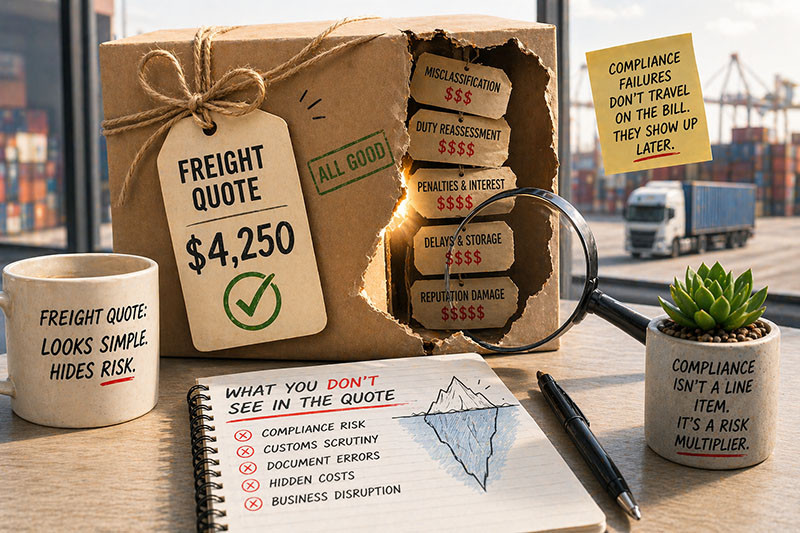
Why Compliance Failures Rarely Show Up in Freight Quotes
Estimated reading time: 9 minutes
In the high-stakes world of global logistics, the initial freight quote is often viewed as the ultimate decision-making tool. Business leaders and supply chain managers scan the lines for the lowest ocean freight rates, the most competitive fuel surcharges, and the fastest transit times. However, there is a dangerous silence within these documents: the absence of compliance risk. Understanding Why Compliance Failures Rarely Show Up in Freight Quotes is essential for any organization looking to protect its bottom line and brand reputation.
A freight quote is essentially a financial snapshot of a “perfect” shipment—a scenario where every document is correct, every regulation is met, and every border crossing is seamless. In reality, the logistics landscape is riddled with shifting trade laws, environmental regulations, and complex customs requirements. When these are overlooked during the quoting phase, the “cheapest” route often becomes the most expensive after accounting for fines, delays, and legal entanglements.
This article explores the systemic reasons why compliance risks remain hidden until it is too late, the true cost of these oversights, and how companies operating in and out of Vietnam can bridge the gap between a quote and a compliant reality.
Table of Contents
- The Transactional Nature of Freight Quoting
- Why Compliance Failures Rarely Show Up in Freight Quotes
- Hidden Hazards: From HS Codes to Sanctions
- The Impact of Non-Compliance on the Supply Chain
- Practical Lessons for Logistics Professionals
- How Scanwell Logistics Vietnam Can Help
- Conclusion
- FAQ
The Transactional Nature of Freight Quoting
At its core, a freight quote is a sales document, not a legal advisory. Logistics providers are often incentivized to present the most attractive “base price” to win a bid. Because compliance is often viewed as the responsibility of the “Importer of Record” (IOR) or “Exporter of Record” (EOR), many forwarders treat it as an external variable rather than a core component of the quote.
When a procurement team requests a quote, they typically provide the origin, destination, weight, and volume. The logistics provider then calculates the cost of space on a vessel or aircraft and the local trucking fees. This process focuses on the movement of goods rather than the legality of the goods. This transactional focus creates a “compliance vacuum” where potential failures—such as improper packaging for hazardous materials or missing permits for specific Vietnamese exports—are simply not factored into the initial price.
Why Compliance Failures Rarely Show Up in Freight Quotes
There are several structural reasons Why Compliance Failures Rarely Show Up in Freight Quotes. To manage a supply chain effectively, decision-makers must recognize that a quote is a promise of service, not a guarantee of regulatory adherence.
1. Quotes Assume “Standard” Conditions
Logistics algorithms and pricing tables are built on the assumption that the cargo is “clean.” They assume the HS (Harmonized System) codes provided are 100% accurate, that no parties involved are on a restricted list, and that all environmental standards are met. If there is a compliance failure—such as a misclassification that leads to a 20% higher duty rate—that cost is “off-balance sheet” for the freight forwarder but a direct hit to the importer’s margin.
2. The Liability Gap
Standard terms and conditions in most freight contracts explicitly state that the shipper is responsible for the accuracy of documentation. Because the financial liability for compliance failures rests with the cargo owner, forwarders often do not invest the time to audit compliance at the quoting stage. This separation of “service provision” and “legal liability” is a primary reason why risks remain invisible until the cargo hits a customs checkpoint.
3. Information Asymmetry
In many cases, the freight forwarder simply doesn’t have enough information at the quoting stage to identify a compliance risk. A quote is often generated based on a generic description like “Electronics” or “Textiles.” Without detailed technical specifications, a logistics provider cannot know if the product requires specific dual-use export licenses or if it violates regional labor standards (such as the UFLPA in the United States).
Hidden Hazards: From HS Codes to Sanctions
While the quote stays flat, the reality of global trade is increasingly volatile. Several specific areas of compliance are notorious for causing “post-quote” financial disasters.
- HS Code Misclassification: This is the most common compliance failure. A slight variation in a product code can change a duty rate from 0% to 35%. Since quotes rarely include duty estimates, this failure is never visible until the entry is filed.
- Rules of Origin: For businesses in Vietnam, leveraging Free Trade Agreements (FTAs) like the EVFTA or CPTPP is vital. If the “Certificate of Origin” is found to be non-compliant, the preferential rates promised in a supply chain model vanish, replaced by standard MFN (Most Favored Nation) rates.
- Sanctions and Denied Party Screening: Global trade lanes are subject to strict sanctions. A freight quote will tell you the cost to ship to a certain port, but it won’t check if your ultimate consignee is on a restricted list. This failure can result in massive legal fines and even criminal charges.
- ESG and Sustainability Mandates: New regulations like the EU Deforestation Regulation (EUDR) require strict data compliance. If your shipment lacks the necessary geolocation data, it could be rejected at the destination, leading to total loss of cargo value—costs never mentioned in a standard freight quote.
The Impact of Non-Compliance on the Supply Chain
When compliance failures occur, the impact radiates far beyond a simple fine. It disrupts the entire rhythm of the supply chain.
Demurrage and Detention: If a shipment is flagged for a compliance audit or lacks a specific permit, it sits at the terminal. Demurrage charges (fees for the container staying in the port) and detention charges (fees for the equipment staying out of the port) can exceed $200–$500 per container per day. These “hidden” costs can easily double the original quoted freight rate within a week.
Inventory Stock-outs: Compliance-related delays are unpredictable. A two-week customs hold can lead to empty shelves, missed production deadlines, and breach of contract penalties with downstream customers. This ruins the ROI (Return on Investment) that the “cheap” freight quote originally promised.
Brand Reputation: In the age of transparency, being caught in a compliance failure—especially one related to labor practices or environmental standards—can cause irreparable damage to a company’s brand. Investors and consumers alike now look for “compliance-first” supply chains.
Practical Lessons for Logistics Professionals
To move beyond the limitations of a standard quote, logistics and HR managers should adopt a “Total Landed Cost” mindset. Here are best practices to ensure compliance is baked into your strategy:
- Audit Before You Quote: Before asking for pricing, perform a preliminary compliance check. Ensure your HS codes are verified by a professional and that your suppliers have the necessary documentation.
- Demand Transparency: Ask your freight forwarder specifically about “contingent costs.” What are the typical customs clearance hurdles for this specific commodity in Vietnam? A partner who answers these questions is more valuable than one who only provides a low number.
- Leverage Technology: Use digital platforms that integrate compliance screening. Automated “Denied Party Screening” and digital document management can catch errors before the goods ever leave the warehouse.
- Choose Partners, Not Vendors: Move away from “lowest-bidder” procurement. Work with forwarders who have dedicated in-house customs brokerage teams who understand local regulations in depth.
How Scanwell Logistics Vietnam Can Help
Scanwell Logistics Vietnam understands that a freight quote is only the beginning of the journey. We pride ourselves on moving beyond the numbers to provide a comprehensive compliance framework for our clients. By integrating regulatory expertise into our logistics solutions, we help businesses avoid the “compliance trap” that often follows a low-cost quote.
Our team in Vietnam is deeply embedded in the local regulatory landscape, providing peace of mind through:
- Expert Customs Brokerage: We don’t just file paperwork; we audit your HS codes and documentation to ensure full compliance with Vietnamese and international laws.
- Global Ocean Freight: Reliable FCL/LCL services backed by a network that understands the specific compliance requirements of every major trade lane.
- Value-Added Warehousing: Ensuring that goods are stored, labeled, and handled according to strict safety and regulatory standards.
- Visibility & Data: Our technology solutions provide real-time tracking and document accessibility, ensuring you always have the “proof of compliance” ready for any audit.
Conclusion
The logistics industry is evolving. The days when a supply chain manager could simply pick the lowest number on a spreadsheet and call it a success are over. As we have explored, the reason Why Compliance Failures Rarely Show Up in Freight Quotes is rooted in the transactional nature of the business and the traditional separation of price from risk.
In today’s complex regulatory environment, the real value of a logistics partner lies in their ability to foresee and mitigate risks. By focusing on compliance at the quoting stage, businesses can protect themselves from the astronomical costs of delays and fines. Remember: a quote gets your goods moving, but compliance keeps them moving.
Call to Action
Ready to turn these logistics insights into real competitive advantages?
Explore Scanwell Logistics Vietnam
Contact our experts for tailored support
FAQ
Why doesn’t my freight quote include customs duties?
Duties are taxes levied by governments based on the product’s value and classification. Because these are subject to change and depend on the accuracy of the importer’s data, they are almost always treated as a separate pass-through cost rather than part of the logistics service quote.
Who is legally responsible if a compliance failure occurs?
In most international shipping terms (Incoterms), the Importer of Record (IOR) is legally responsible for compliance. Even if a forwarder makes a mistake, the government will typically hold the cargo owner liable for fines and penalties.
How can I ensure my freight quote is “compliance-ready”?
Work with a partner like Scanwell Logistics Vietnam that offers integrated customs brokerage. Ask them to review your commercial invoice and packing list before finalizing the quote to identify any potential red flags in HS classification or regional trade restrictions.