










The True Cost of Getting Compliance ‘Mostly Right’
Estimated reading time: 8 minutes
In the world of international trade, there is a dangerous misconception that being “mostly compliant” is enough to keep a supply chain moving. Many businesses operate under the assumption that if 95% of their paperwork is accurate, the remaining 5% represents a negligible risk—a rounding error in the grand scheme of global logistics. However, in the eyes of customs authorities and regulatory bodies, compliance is binary: you are either compliant, or you are not. There is no middle ground when a shipment is flagged at a port of entry.
The logistics landscape in 2024 and beyond is increasingly governed by a complex web of local and international regulations. From shifting HS code classifications to stringent environmental reporting and labor standards, the “The True Cost of Getting Compliance ‘Mostly Right’” often manifests in ways that far exceed the initial cost of doing things correctly from the start. For companies operating in or through Vietnam, where trade volumes are surging, the margin for error is shrinking, making robust compliance a competitive necessity rather than a back-office burden.
This article explores the multi-faceted risks of partial compliance, the evolving regulatory environment, and how logistics leaders can transition from a reactive “mostly right” mindset to a proactive, “always right” strategy. By understanding the hidden traps of compliance, business leaders can safeguard their operations against avoidable delays, financial penalties, and long-term brand damage.
Table of Contents
- The Myth of “Mostly Right” in Modern Trade
- The True Cost of Getting Compliance ‘Mostly Right’: Financial and Operational Impacts
- Emerging Regulatory Challenges in Global Logistics
- Practical Lessons for Ensuring Full Compliance
- How Scanwell Logistics Vietnam Can Help
- Conclusion
- FAQ
The Myth of “Mostly Right” in Modern Trade
In many departments, “mostly right” is a passing grade. If a marketing campaign reaches 90% of its target audience, it is a success. If a warehouse fulfills 98% of orders on time, it is performing well. But in trade compliance, “mostly right” is simply a delayed realization of failure. A single incorrect Harmonized System (HS) code or a missing certificate of origin can bring an entire production line to a standstill.
Logistics compliance is the backbone of the global supply chain. It involves adhering to the laws, regulations, and requirements set by various governments regarding the movement of goods across borders. This includes everything from import/export declarations and tax payments to adhering to sanctions and safety standards. When a company settles for “mostly right,” they are essentially gambling on the likelihood of an audit.
Why Partial Compliance Fails
- Binary Enforcement: Customs officials do not give partial credit. A shipment with one incorrect document is treated with the same scrutiny as a shipment with no documents.
- The Domino Effect: One flagged shipment at a hub can lead to “red-channel” status for all future shipments, causing a permanent slowdown in your logistics network.
- Increased Audit Frequency: Patterns of minor errors signal to authorities that a company lacks internal controls, triggering more frequent and deeper audits.
The True Cost of Getting Compliance ‘Mostly Right’: Financial and Operational Impacts
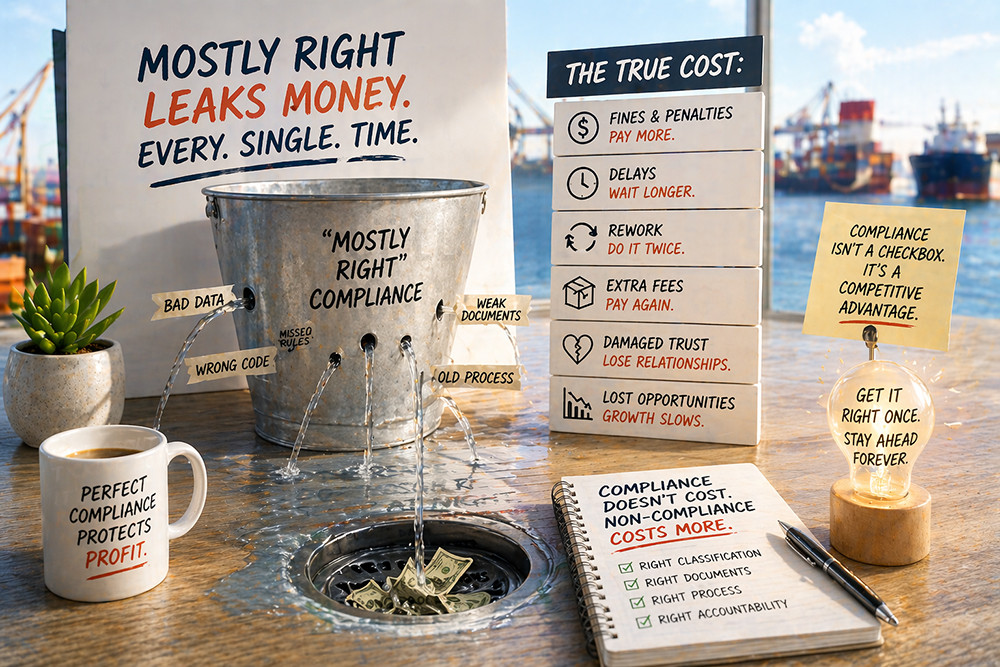
The financial implications of compliance errors are often far higher than the cost of hiring expert customs brokerage services. The true cost of getting compliance ‘mostly right’ is divided into visible and invisible expenses that can erode a company’s profit margins overnight.
Visible Costs: Fines and Demurrage
The most immediate impact is the financial penalty. Customs authorities impose fines based on the severity of the misdeclaration and the amount of underpaid duties. Furthermore, while goods are held for inspection or pending corrected paperwork, they accrue demurrage and detention charges. In high-volume ports, these daily fees can quickly reach thousands of dollars, often exceeding the value of the cargo itself.
Invisible Costs: Opportunity and Reputation
Operational disruptions are perhaps more damaging than the fines themselves. When cargo is stuck, production lines may stop, resulting in idle labor and missed deadlines. For businesses in the electronics or fashion industries, where product lifecycles are short, a two-week delay can mean the difference between a profitable season and obsolete inventory.
- Loss of Trust: Customers who do not receive their goods on time will eventually look for more reliable partners.
- Supply Chain Bullwhip: Small delays at the port amplify into major shortages down the line, affecting distribution centers and retail outlets.
- Revocation of Licenses: Repeat offenders may lose their status as “Trusted Traders” or “Authorized Economic Operators” (AEO), losing the privilege of expedited clearance.
Emerging Regulatory Challenges in Global Logistics
The bar for what constitutes “compliance” is constantly rising. Global trade is no longer just about paying the right tax; it is increasingly about data transparency and ethical sourcing. This evolution makes it even harder to stay “mostly right” without a dedicated strategy.
In recent years, we have seen a surge in regulations focused on the “invisible” parts of the supply chain. This includes labor practices deep within the tiers of suppliers and the environmental footprint of transportation modes.
Key Trends Shaping Compliance
- Digitalization of Customs: Governments are moving toward fully digital platforms (like VNACCS/VCIS in Vietnam). These systems use AI to flag inconsistencies in data faster than any human agent could.
- Sustainability Reporting: New mandates require companies to report CO2 emissions across their logistics network, adding another layer of compliance complexity.
- Security and Sanctions: Rapidly changing geopolitical landscapes mean that “mostly right” regarding who you do business with can lead to severe legal repercussions.
Practical Lessons for Ensuring Full Compliance
Transitioning from a reactive to a proactive compliance culture requires a structured approach. Logistics professionals should focus on these key areas to mitigate the risks associated with the true cost of getting compliance ‘mostly right’.
- Conduct Regular Internal Audits: Don’t wait for customs to find an error. Periodically review your HS classifications, valuation methods, and country-of-origin claims to ensure they align with the latest regulations.
- Invest in Continuous Training: Regulatory environments change. Ensure your logistics and procurement teams are trained on new trade agreements (such as the EVFTA or CPTPP) and their specific documentation requirements.
- Implement End-to-End Visibility: Use logistics technology to track documents as closely as you track the physical cargo. Digitalizing your “paper trail” ensures that all stakeholders have access to accurate information in real-time.
- Partner with Local Experts: In complex markets like Vietnam, local nuances in customs procedures can be the difference between clearance in hours or days. Leverage a partner who understands the local regulatory landscape.
How Scanwell Logistics Vietnam Can Help
At Scanwell Logistics Vietnam, we understand that compliance is the foundation of a resilient supply chain. We don’t settle for “mostly right.” Our team of experts works closely with clients to ensure that every shipment, whether by air, sea, or land, meets the most stringent regulatory requirements.
By combining global reach with deep local knowledge, we help businesses navigate the complexities of Vietnam’s customs procedures, trade agreements, and documentation standards. We act as an extension of your team, providing the peace of mind that comes with knowing your logistics compliance is in professional hands.
- Customs Brokerage: Expert handling of declarations to minimize delays and maximize accuracy.
- Ocean & Air Freight: Seamless transport solutions with fully integrated compliance checks.
- Warehousing & Distribution: Secure facilities that adhere to safety and inventory compliance standards.
- Trade Advisory: Helping you stay ahead of regulatory changes and leverage free trade agreements effectively.
- Supply Chain Visibility: Real-time tracking and digital documentation management.
Conclusion
The true cost of getting compliance ‘mostly right’ is a price no modern business can afford to pay. While the immediate savings of cutting corners might seem attractive, the long-term consequences—ranging from heavy fines and cargo seizures to irreparable brand damage—far outweigh the benefits. In an era where supply chains are under constant scrutiny from both regulators and consumers, total compliance is the only viable strategy.
As logistics and supply chain managers, the goal must be to build a culture of precision. This involves investing in the right people, the right technology, and the right partners. By prioritizing compliance today, you ensure the agility and reliability of your supply chain tomorrow.
Call to Action
Ready to turn these logistics insights into real competitive advantages?
Explore Scanwell Logistics Vietnam
Contact our experts for tailored support
FAQ
What are the most common compliance mistakes in Vietnam?
The most frequent errors involve incorrect HS code classification and inaccuracies in the declared value of goods. These mistakes often lead to underpayment of duties, which triggers automatic penalties from Vietnamese customs authorities.
How does “mostly right” affect my company’s risk profile?
Customs authorities keep a history of your transactions. Frequent “minor” corrections lead to a higher risk rating, meaning a larger percentage of your future shipments will be selected for physical inspection, increasing lead times and costs.
Can a freight forwarder help mitigate compliance risks?
Yes. An experienced partner like Scanwell Logistics Vietnam provides a second layer of defense by reviewing documentation before submission, advising on trade agreements, and ensuring that all regulatory requirements are met before the cargo even reaches the port.